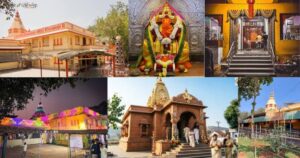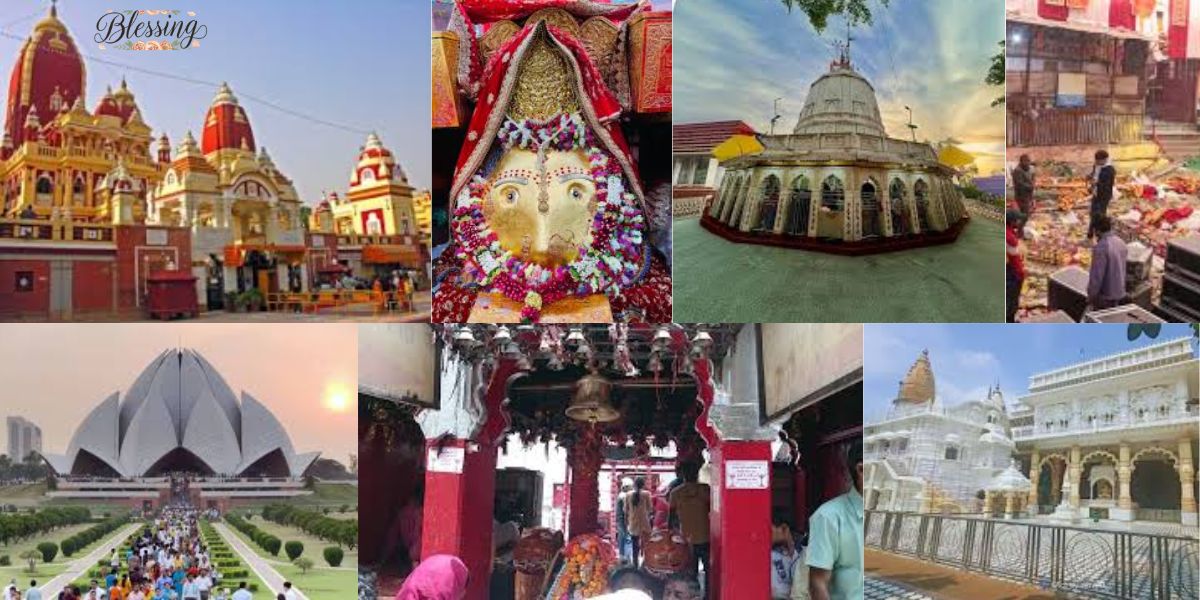
Kalkaji Mandir is one of the most powerful Shaktipeeth temples Delhi has to offer. It sits in South Delhi, right opposite the Lotus Temple, Nehru Place area, and welcomes lakhs of devotees every year. The temple is dedicated to Goddess Kalka / Maa Kali, a fierce and divine form of Maa Durga, and is believed to be a self-manifested goddess temple in India.
Kalkaji Mandir Daily Darshan Timings 2026
The temple opens at 4:00 AM every morning, making it perfect for early devotees. It stays open until 11:30 PM at night, seven days a week, including public holidays.
This temple’s opening time in Delhi 2026 remains consistent throughout the year, except during short aarti breaks. During the Navratri Delhi temple seasons, the temple may remain open overnight for special jagran sessions.
Festival Special Timings
During Chaitra Navratri and Kartik months, overnight darshan is commonly available. Special Jagran festival events in Delhi are held with non-stop bhajans and devotional music.
Devotees participating in these events experience a deeply spiritual all-night atmosphere. Always confirm the festival schedule with the temple office before planning an overnight visit.
Kalkaji Mandir Aarti Timings 2026
Four daily aartis are conducted at fixed times throughout the day. The Mangala aarti ritual at 4:30 AM marks the divine start of the spiritual day.
The Bhog Aarti at 12:00 PM is when the sacred bhog prasad offering is made to the goddess. The Sandhya Aarti at 7:00 PM and the Shayan Aarti at 10:30 PM complete the daily aarti schedule.
| Aarti Name | Timing |
| Mangala Aarti (Morning) | 4:30 AM |
| Bhog Aarti (Noon) | 12:00 PM |
| Sandhya Aarti (Evening) | 7:00 PM |
| Shayan Aarti (Night) | 10:30 PM |
Navratri Special Aarti Experience
During Sharad Navratri celebrations, the aartis become grander and longer than usual. Live dhols, bhajans, and devotional performances fill the air around the temple.
Thousands of devotees gather for the Navratri special puja and Delhi aarti sessions. Attending the Sandhya Aarti during Navratri is one of the most unforgettable spiritual experiences in Delhi.
Read More: Golden Temple Vellore Timings 2026, Darshan, Dress Code, Entry Fees & Pooja Details
Kalkaji Mandir VIP Darshan Pass – Price and Details
The VIP Darshan Pass helps devotees manage long queues through smart darshan queue management. The pass costs between ₹150 and ₹300 per person and is available during major festivals.
Note: VIP pass booking temple is not available online. All passes must be bought at official temple counters. This pass is highly recommended for elderly devotees, families with children, and large pilgrimage groups.
| Feature | General Darshan | VIP Darshan |
| Queue Time | 30–90 minutes | 5–10 minutes |
| Cost | Free | ₹150 – ₹300 |
| Best For | Regular daily visits | Navratri & festivals |
| Online Booking | Not required | Not available |
| Availability | Every day | Festival days only |
| Ideal For | All devotees | Elderly, families, groups |
Best Time to Visit Kalkaji Mandir Delhi
Early morning from 5:00 AM to 7:00 AM is the best time to avoid crowds at the templein Delhi. Late evenings after 8:00 PM are also peaceful and offer a quieter darshan experience.
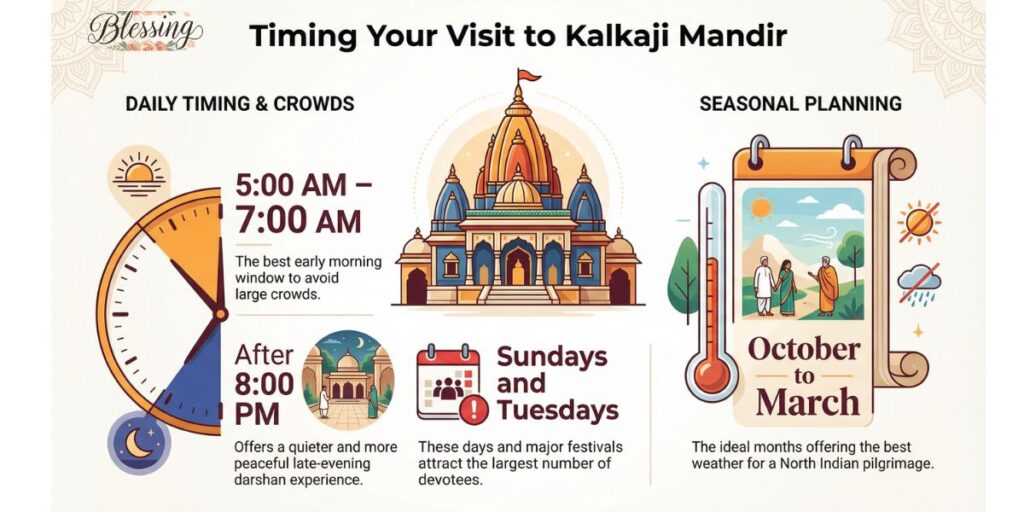
Sundays, Tuesdays, and all major festival days bring the largest number of devotees, so plan accordingly. The months from October to March offer the best weather for your Hindu pilgrimage to North India.
How to Reach Kalkaji Mandir
The nearest metro is the Kalkaji Mandir Metro Station on both the Violet line metro in Delhi and the Magenta line metro station.
The station is just a 5-minute walk from the temple entrance, making it extremely convenient. Hazrat Nizamuddin Station is about 7 km away for those arriving by train from outside Delhi.
Indira Gandhi International Airport is 20 km away. Autos, taxis, and e-rickshaws from Nehru Place and Govindpuri are easily available.
How far is Kalkaji Mandir from Nehru Place?
Kalkaji Mandir is just 1–2 km from Nehru Place, making it a short auto or walk away. The Lotus Temple, Nehru Place area, is located directly opposite Kalkaji Mandir.
Both landmarks share the same neighborhood, so you can visit both on the same trip. The easy connectivity via metro makes this one of the most accessible temples in all of Delhi.
how to get kalkaji mandir vip pass
Visit the temple during Navratri or a major festival. Go to the official VIP counter inside the temple. Pay ₹150 to ₹300 per person in cash. Online booking is not available, so visit in person only.
. Facilities Available at Kalkaji Mandir
Free shoe storage counters are available just outside the main temple entrance. Drinking water and clean washrooms are provided inside the temple complex.
Lockers for bags and valuables are available near the entry gate. Wheelchair access is available for elderly and differently-abled devotees on request.
Kalkaji Mandir Address and Location Details
The full address is Block 9, Kalkaji, New Delhi, Delhi 110019, India. The temple is situated directly opposite the Lotus Temple in South Delhi.
It is one of the most centrally located Kali mandir temples in North India, easily reached by all modes of transport. The Google Plus Code is G7X5+QMQ for precise GPS navigation on Google Maps.
What to Offer and How to Do Darshan Step by Step
Begin by collecting red chunri, coconut, and marigold flowers from stalls outside. Remove footwear, wash hands, and enter through the eastern gate for direct idol view.
Offer the chunri and flowers at the sanctum and fold hands in prayer. Collect your prasad from the priest and exit from the left side of the sanctum.
Dress Code and Temple Etiquette
Always wear modest, traditional Indian attire when entering the temple premises. Avoid shorts, mini skirts, or sleeveless tops as they are considered disrespectful inside the temple.

Follow the queue system at all times and cooperate with temple staff and volunteers. Carry minimal belongings to move freely, especially during busy Navratri Delhi temple days.
Tips for a Smooth and Hassle-Free Darshan
- Arrive at least 30 minutes before aarti times for the best viewing spots near the sanctum.
- Avoid the midday peak from 10:00 AM to 2:00 PM. This is when crowds are at their heaviest.
- During festivals, use the VIP pass booking temple counter to get faster access and skip long lines.
- Carry prasadam and water, wear comfortable footwear, and keep your phone on silent inside the temple.
Who is Maa Kalka Ji: The Powerful Goddess of Delhi’s Siddha Peetha
Goddess Kalka / Maa Kali is one of the most fierce and revered forms of Maa Durga in Hinduism. She represents courage, divine protection, and the ultimate triumph of good over evil.
The Kalkaji Mandir is known as the Manokamna Siddha Peetha, meaning the temple that fulfills wishes. It is also called the Jayanti Peetha Delhi, holding immense Siddha Peetha significance among Hindu devotees across India.
Why Devotees Worship Maa Kalka Ji
Devotees believe that Maa Kalka Ji destroys negativity and grants heartfelt desires. She is considered the divine guardian of Delhi, protecting those who pray with sincere faith.
This Maa Durga temple in South Delhi draws pilgrims from every state in India, especially during Navratri. The goddess’s self-manifested temple in India makes this shrine even more spiritually powerful and unique.
History of Kalkaji Mandir
The current structure was built around 1764 AD by the Marathas, showcasing classic Maratha temple architecture.

In 1816, Mirza Raja Kidar Nath, the treasurer of Mughal King Akbar Shah II, expanded the temple significantly. The Thok Jogians / Shamlat Thok Brahmins have managed the daily puja rituals here for centuries.
Folklore also connects this sacred site to the Mahabharata era, when the Pandavas and Kauravas performed rituals here.
Land Ownership and the Thok Jogians Puja Tradition
The land belongs to the community following the Thok Jogians puja tradition and Shamlat Thok Brahmins.
These families have preserved the ancient rituals and daily puja practices for generations. Their dedication ensures that the temple’s spiritual heritage remains unbroken and authentic.
Architecture of Kalkaji Mandir
The temple is built on a brick foundation finished with elegant white marble and plaster. A pyramid-shaped tower rises above the main structure, giving the mandir a majestic and commanding presence.
The central chamber showcases a rare 12-sided temple architecture in India, with each side having its own entrance.
A total of 36 exterior arches frame the outer gallery, creating one of the most stunning temple layouts in North India.
The Sacred Idol and Decorative Details
A marble pedestal at the center holds the carved stone idol of Goddess Kalka / Maa Kali. A stone trident stands before the idol, and red sandstone tiger statues guard both sides of the goddess.
Nastaʿlīq inscription temple style calligraphy adorns the pedestal, blending Islamic artistry with Hindu devotion beautifully. Visitors entering from the eastern entrance get the most powerful and direct view of the sacred idol.
Nearby Places to Visit After Kalkaji Mandir
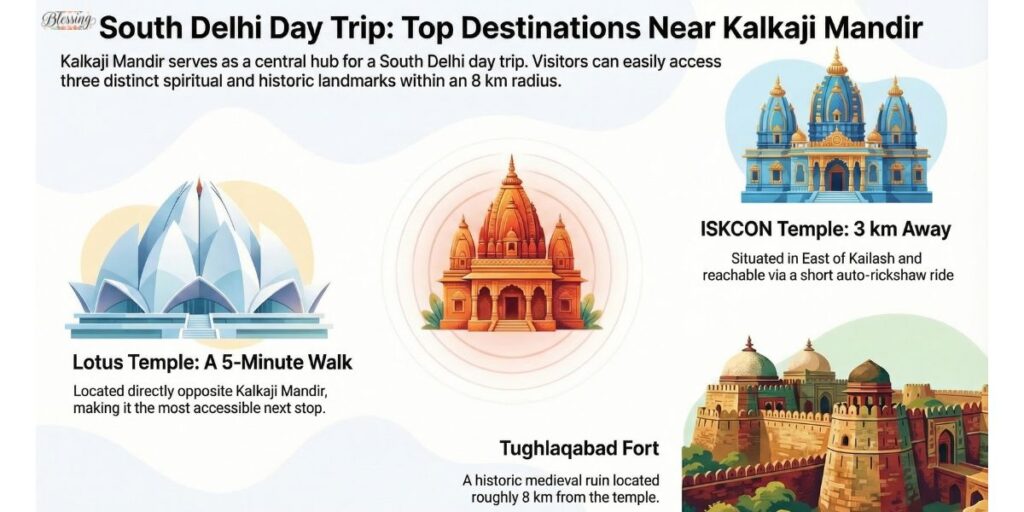
The Lotus Temple is directly opposite and takes only 5 minutes to walk. ISKCON Temple in East of Kailash is just 3 km away by auto.
Tughlaqabad Fort, a historic medieval ruin, is roughly 8 km from the temple. All three spots can comfortably be covered in a single South Delhi day trip.
Important Festivals Celebrated at Kalkaji Mandir Throughout the Year
Chaitra and Sharad Navratri are the two biggest festivals celebrated here every year. Monthly Ashtami dates draw large crowds of devoted Maa Kali worshippers.
Diwali puja at Kalkaji Mandir holds special significance as Maa Kali is worshipped on that night. Makar Sankranti and Durga Puja are also observed with special rituals and decoration.
Photography, Mobile, and Security Rules Inside the Temple
Photography
- No photography allowed inside the main sanctum
- Clicking photos in outer premises is permitted
- Reels and video shooting are strictly not allowed
- Always ask temple staff before taking any photo
Mobile Phones
- Keep your mobile on silent before entering
- Avoid taking calls inside the temple hall
- Mobile use is restricted near the idol area
- Step outside if you need to make a call
Security Rules
- Bags and backpacks must be deposited at the entry counter
- Sharp objects, lighters, and food packets are not allowed inside
- Security check is mandatory for every visitor at the gate
- Cooperate with temple guards for a smooth entry
General Rules
- Remove footwear before the entrance gate
- Do not touch the idol or sanctum walls
- Maintain silence inside the inner temple area
- Follow queue discipline at all times
Personal Opinion & Recommendation
In my personal experience, Kalkaji Mandir is best visited at the crack of dawn, when the temple is calm, and the energy is purest. The Mangala aarti ritual at 4:30 AM is an extraordinary experience. I strongly recommend taking the Violet line metro from Delhi to Kalkaji Mandir Metro Station for the smoothest and hassle-free darshan experience in 2026.
Frequently Asked Questions
What time does Kalkaji Mandir open today?
Kalkaji Mandir opens at 4:00 AM every day, including Sundays and public holidays. It closes at 11:30 PM.
Is Kalkaji Mandir open on Sunday?
Yes, the temple is open on Sundays from 4:00 AM to 11:30 PM. Expect heavy crowds, especially in the morning and during festival weeks.
What time is Aarti at Kalkaji Mandir?
The four daily aartis are at 4:30 AM, 12:00 PM, 7:00 PM, and 10:30 PM. The aarti schedule at Kalkaji remains the same throughout the year.
How do I get a VIP pass at Kalkaji Mandir?
Visit the official VIP counter inside the temple during Navratri or major festivals. No VIP pass booking temple option is available online.
Can I book the Kalkaji Mandir darshan pass online?
No, online booking is currently not available. All passes must be purchased in person at the official temple counters during festivals.
Conclusion
Kalkaji Mandir is a timeless spiritual destination that every devotee should experience at least once. Whether you come during the vibrant Navratri Delhi temple season or a quiet weekday morning, the divine energy here is unmatched. Plan your visit using the updated darshan timing update 2026, dress modestly, and follow the temple etiquette for a blessed experience. Jai Maa Kalka .

Alich, a skilled content writer with 3+ years of experience, known for creating clear guides and 1000+ published articles across multiple niches.