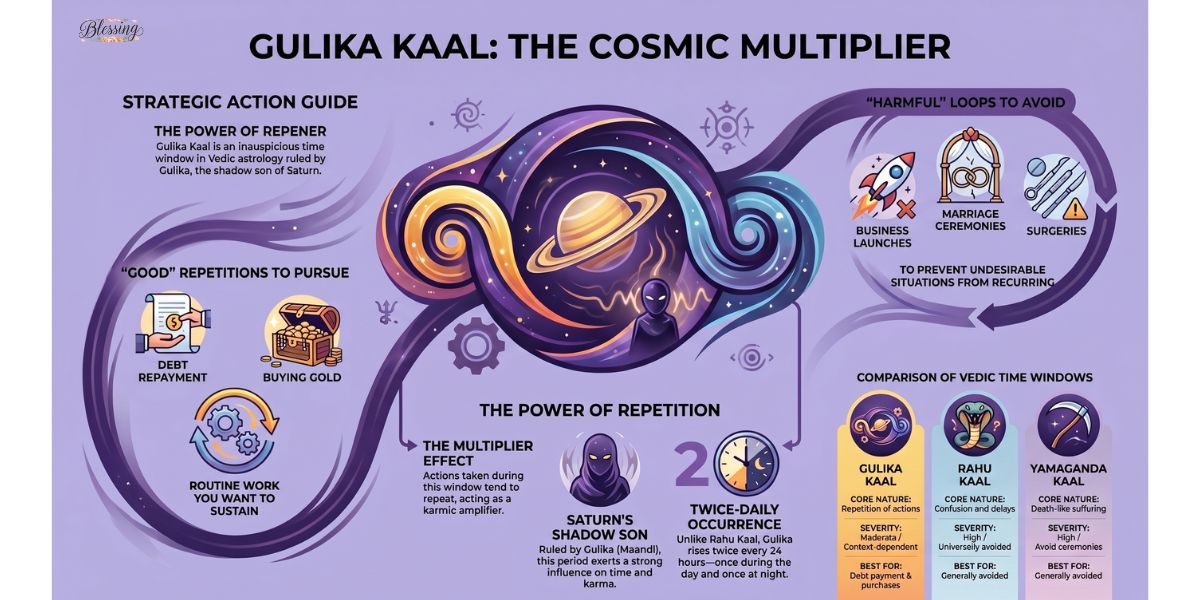
Gulika Kaal is a powerful inauspicious time period in Vedic astrology timings. It is ruled by Saturn’s son in astrology and repeats actions performed within it. At BlessingIdeas, we break it down simply so you can plan your day wisely.
Gulika Kaal Time in New Delhi
Today in New Delhi, Gulika Kaal runs from 01:58 PM to 03:40 PM. This timing is based on the local sunrise to sunset division for the city.
The period lasts approximately one hour and forty-two minutes today. Always check your city’s daily panchang timings on BlessingIdeas for the exact local window.
Gulika, also called Maandi Kaal, is a sub-planet Saturn satellite in Vedic astrology timings. It does not occupy a fixed planetary position but exerts a strong karmic influence on time.
Ancient seers recognized its effect and mapped it carefully into the Hindu muhurat chart. Today’s city-specific timing for other locations like Mumbai, Chennai, or Bengaluru will differ slightly from New Delhi’s reference time.
The most unique feature of Gulika Kaal is that it rises twice daily. Once during daylight and once at night.
This is unlike Rahu Kaal and Yamaganda Kaal, which occur only once during the day. This twice-daily rising is the root of its core principle: any action taken during this period tends to repeat. BlessingIdeas recommends checking this timing before any significant personal or business decision.
Reference timing shown is for New Delhi, India. The day-of-week variation in calculation means timings shift every day. Always use the Panchang specific to your city for precision.
Read More: Yamaganda Kaal Time in Bangalore — 10 May 2026 (Sunday)
What Is Gulika Kaal in Astrology?
Gulika Kaal in astrology is one of the three major celestial inauspicious windows in the Hindu calendar time system. The other two are Rahu Kaal and Yamaganda Kaal.
All three are calculated using the same base method, dividing the daytime division between sunrise and sunset into eight equal parts.
Gulika’s segment shifts based on the day of the week astrology rule, starting from Saturday and moving backward through the week.
The Kaal calculation method places Gulika in the 7th segment on Sunday, 6th on Monday, 5th on Tuesday, 4th on Wednesday, 3rd on Thursday, 2nd on Friday, and 1st on Saturday.
This backward movement reflects Saturn’s retrograde nature as the ruling force behind Gulika.
Unlike a standard planetary period, Gulika is a Vedic time segment that operates like a shadow influence.
Many astrologers in South India, especially Kerala, consider Gulika’s position in the natal chart as significant as the Moon’s placement.
The Mythological Origin of Gulika
The story of Gulika traces back to the Treta Yuga during the era of Lord Rama. Ravana, the powerful king of Lanka, had enslaved the nine planets and forced them to reside in the 11th house of his firstborn’s birth chart.
When Meghanada was about to be born, all planets obeyed, except Lord Shani (Saturn). Shani secretly slipped into the 12th house to deny Ravana’s son the perfect horoscope.
Ravana, enraged at Shani’s defiance, cut off Saturn’s feet in fury. Those severed feet transformed into a new entity, Gulika, the shadow son of Saturn.
This mythological origin explains why Gulika carries strong karmic and sometimes malefic influence.
BlessingIdeas references this origin because understanding the “why” behind a Vedic astrology timing always deepens respect for the practice.
What Activities Are Suitable or Should Be Avoided During Gulika Kaal?
The core logic of Gulika Kaal is simple: whatever you do during this window tends to repeat. That makes it genuinely useful for some tasks and genuinely harmful for others.
Think of it as a multiplier, it amplifies the nature of your action, whether good or bad. This is why careful task suitability by time planning matters so much in the daily Hindu timing system.
✅ What You Can Do:
- Debt repayment timing, pay loans so the debt does not recur
- Buying a vehicle, repetition of purchases is welcome
- Buying gold or property for long-term prosperity
- Routine tasks and daily work already in progress
- Prayers for health if you want healing to repeat
- Planting seeds for long-term growth
What to Avoid:
- Business commencement timing, do not launch new ventures
- Contract signing avoidance, delays and disputes may repeat
- Journey start timing, avoid beginning new travel
- Marriage ceremony timing, marital issues could repeat
- Funeral rites, grief and loss should not recur
- Medical surgeries or one-time treatments
How Is Gulika Kaal Calculated?
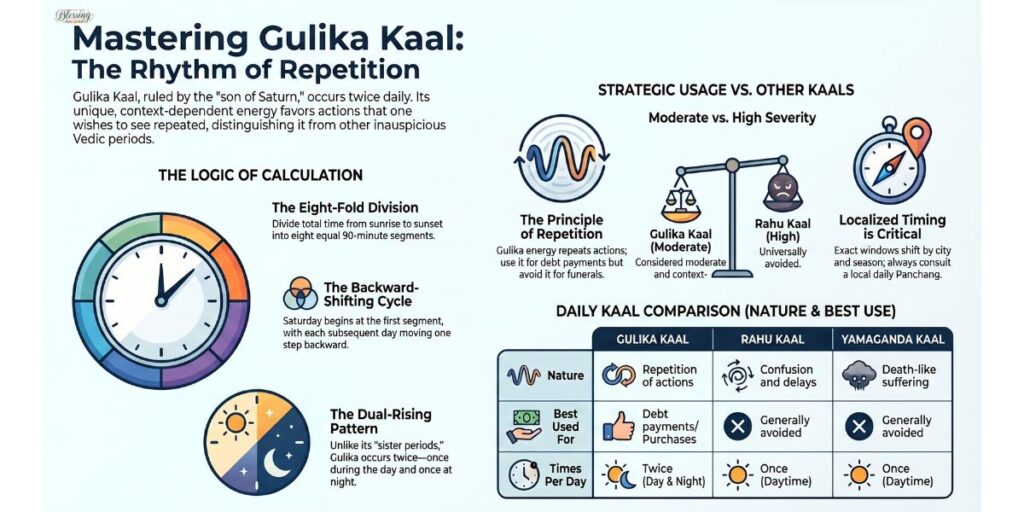
The Kaal calculation method for Gulika mirrors the approach used for Rahu Kaal and Yamaganda Kaal.
The total daytime, from sunrise to sunset, is divided into eight parts of the day called muhurats.
Each muhurat spans roughly 90 minutes on a standard 12-hour day. The specific part assigned to Gulika depends entirely on the day of the week astrology rule.
Saturday begins the cycle at the 1st segment, and each subsequent day moves the Gulika window one step backward.
Friday takes the 2nd, Thursday the 3rd, and so on through Sunday at the 7th. Because actual sunrise and sunset times vary by city and season, the exact duration also shifts slightly each day.
This is precisely why BlessingIdeas recommends checking your local daily panchang timings rather than relying on a fixed table.
Night Gulika is also calculated separately, using sunset to next sunrise as the base. Most people focus on the daytime window, but some traditional practitioners account for both.
The twice-daily occurrence is what distinguishes Gulika from its sister inauspicious periods. This dual-rising pattern reinforces the “repetition of actions” principle at the heart of Gulika’s energy.
Read More: Sunrise and Sunset Time in Varanasi Today — Complete Panchang Guide
Comparison Table: Gulika Kaal vs Rahu Kaal vs Yamaganda Kaal
| Feature | Gulika Kaal (Maandi) | Rahu Kaal | Yamaganda Kaal |
|---|---|---|---|
| Ruling Body | Gulika — son of Saturn | Rahu (shadow planet) | Yamaghanta |
| Nature | Repetition of actions | Confusion, delays, failure | Death-like suffering |
| Times Per Day | Twice (day + night) | Once (daytime) | Once (daytime) |
| Duration | ~90 minutes | ~90 minutes | ~90 minutes |
| Can Be Used For | Debt payment, vehicle purchase, good recurring acts | Generally avoided entirely | Generally avoided entirely |
| Worst For | New businesses, marriages, funerals, surgeries | All new beginnings, travel, contracts | All auspicious ceremonies |
| Calculation Base | Sunrise to Sunset ÷ 8 | Sunrise to Sunset ÷ 8 | Sunrise to Sunset ÷ 8 |
| Found in Panchang? | Yes — Tithi nakshatra muhurat pages | Yes — listed prominently | Yes — alongside Rahu Kaal |
| Severity | Moderate — context-dependent | High — universally avoided | High — especially for ceremonies |
Gulika Kaal and the Daily Panchang
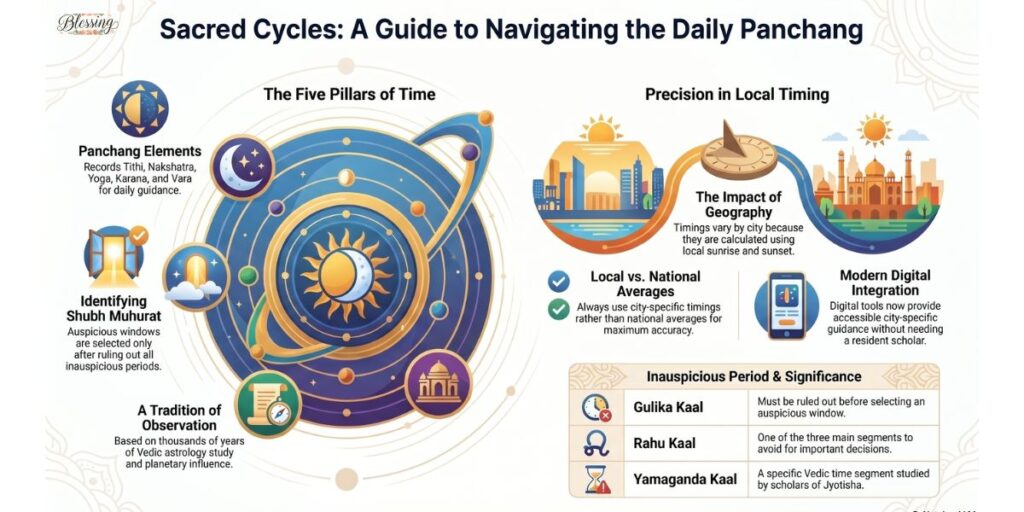
The Panchang is the traditional Hindu almanac that records the five key elements of each day: tithi, nakshatra, yoga, karana, and vara.
Gulika Kaal, along with Rahu Kaal and Yamaganda Kaal, is always listed alongside these five elements in any complete daily panchang timings reference.
Checking the Panchang before important decisions is an ancient practice, one BlessingIdeas is proud to bring into everyday modern life.
The shubh muhurat (auspicious window) is typically selected only after confirming all three inauspicious periods have been ruled out.
Every city has a different Panchang because timings are calculated based on local sunrise and sunset.
This means Gulika Kaal time today in Mumbai will differ from New Delhi, Bengaluru, Chennai, or Hyderabad.
BlessingIdeas provides city-specific Panchang timing guidance for this exact reason. Always prefer a city-specific timing reference rather than a national average for maximum accuracy.
The planetary influence on time is not superstition for millions of practicing Hindus, it is a lived tradition backed by generations of observation.
Scholars of Jyotisha (Vedic astrology) have studied these Vedic time segments for thousands of years.
Modern practitioners combine classical Panchang wisdom with today’s digital tools to make it accessible.
BlessingIdeas bridges that gap so every reader can use this knowledge without needing an astrologer on speed dial.
Personal Experience and Recommendation
I started checking Gulika Kaal before signing any business paperwork about two years ago. One day I accidentally scheduled a vendor call during this window and the deal had to be renegotiated three times. Since then, I always open the daily panchang timings first thing every morning. BlessingIdeas makes this habit effortless, and I genuinely believe it has helped me avoid unnecessary delays.
Frequently Asked Questions About Gulika Kaal
What is Gulika Kaal in astrology?
Gulika Kaal is an inauspicious time period in Vedic astrology timings, ruled by Gulika, a shadow sub-planet and son of Saturn, also called Maandi Kaal. Any action performed during this window tends to repeat itself.
Is Gulika Kaal good or bad?
It is generally avoided for new beginnings. However, it is good for debt repayment timing, buying vehicles, or any act you want to recur, making it context-dependent rather than entirely negative.
How is Gulika Kaal calculated?
The Kaal calculation method divides the sunrise to sunset period into eight parts of the day. The segment assigned to Gulika shifts daily based on the day of the week astrology rule, starting on Saturday and moving backward.
Is Gulika Kaal worse than Rahu Kaal?
In the Rahu Kaal comparison, Rahu Kaal is considered more universally dangerous for new ventures. Gulika Kaal is unique because its repetition nature means it can be used beneficially for certain tasks, unlike Rahu Kaal, which is simply avoided entirely.
Should I travel or sign a contract during Gulika Kaal?
No, journey start timing and contract signing during Gulika Kaal are strongly avoided in Vedic astrology. Starting a trip or signing documents during this window risks the situation repeating in undesirable ways.
Conclusion
Gulika Kaal is far more nuanced than a simple “bad time” label suggests. Governed by the sub-planet Saturn’s son, its core principle of repetition of actions makes it a tool,not just a warning. Avoid marriage ceremony timing, business commencement, and contract signing within this window. But confidently use it for debt repayment timing, routine work, or auspicious recurring goals.

Alich, a skilled content writer with 3+ years of experience, known for creating clear guides and 1000+ published articles across multiple niches.