Chanting a Mahadev mantra daily can transform your life from the inside out. These ancient Sanskrit chanting traditions have helped millions find inner peace, success, and spiritual awakening. At BlessInIdeas, we give you all 21 powerful Shiva mantras , with meanings, benefits and pronunciation . So you can start today.
What is Mahadev Mantra? Understanding the Sacred Vibrations
A Mahadev mantra is a sacred sound formula dedicated to Lord Shiva in Hindu prayer tradition. “Mahadev” literally means “Great God” in Sanskrit.
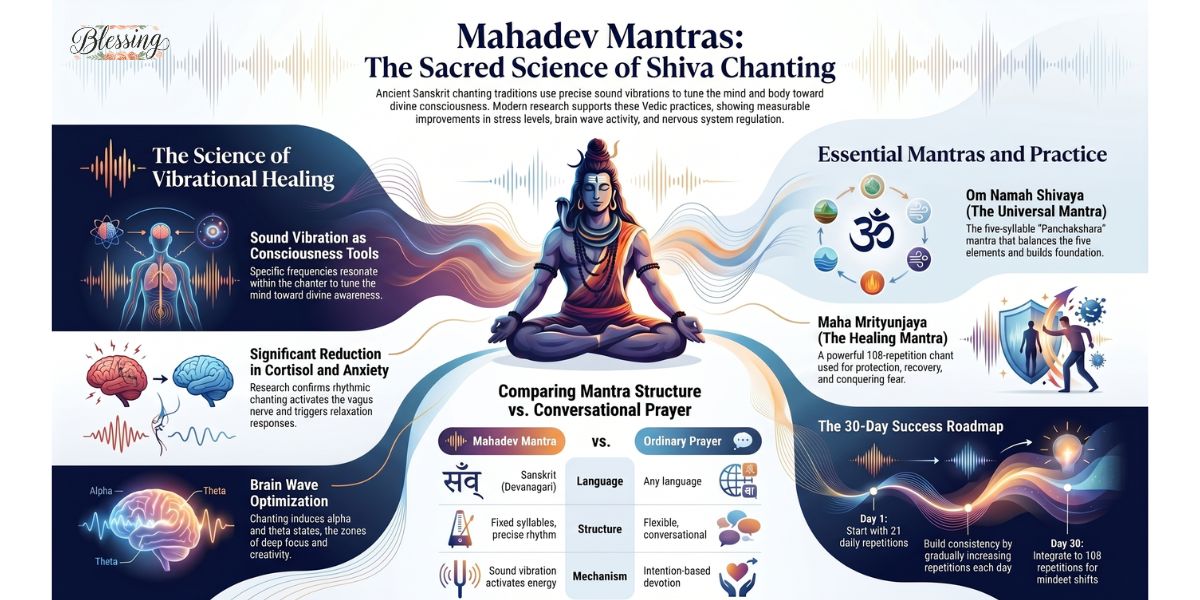
These mantras are not just words .They are precise sound vibration consciousness tools that tune your mind and body toward divine consciousness.
Each Mahadev mantra carries a specific vibrational frequency. When you chant with focus and sincerity, that frequency resonates inside you.
Think of it as a direct line to Shiva’s boundless energy. The more consistently you practice japa meditation, the stronger that connection grows.
What makes Mahadev mantras different from ordinary prayers?
| Feature | Mahadev Mantra | Ordinary Prayer |
|---|---|---|
| Language | Sanskrit (Devanagari script) | Any language |
| Structure | Fixed syllables, precise rhythm | Flexible, conversational |
| Mechanism | Sound vibration activates energy centers | Intention-based devotion |
| Repetition | 11, 21, 54, or 108 times | No fixed count |
| Tradition | Vedic chanting lineage (thousands of years) | Varies by religion |
| Accessibility | Open to all sincere seekers | Religion-specific |
The Spiritual Science Behind Mantras
Ancient Vedic masters understood shabda brahman ,the idea that sound itself IS the divine. Every syllable in the Devanagari script carries specific energy.
The Panchakshara mantra (Om Namah Shivaya) maps directly to the five elements: earth, water, fire, air, and space. Mantra science explanation starts here , with sound as the foundation of all creation.
Modern research now supports this ancient wisdom. Vagus nerve activation occurs during rhythmic chanting, triggering the body’s relaxation response.
A published study in the International Journal of Pharmaceutical Sciences confirmed significant reduction in stress hormones cortisol and anxiety after regular Om Namah Shivaya chanting.
Brain wave changes meditation research shows chanting induces alpha and theta states, the zones of deep focus and creativity.
Why Shiva Mantras Hold Transformative Power
Lord Shiva is not just a deity , he represents the ultimate reality beyond form and duality. Chanting his mantras connects you to that formless awareness.
This is why Shiva mantra for success works: it doesn’t just attract external results , it transforms the person seeking them.
Swami Vivekananda taught that religion is realization, not ritual. Shiva mantras embody that truth. The Isha Foundation, founded by Sadhguru, has introduced millions globally to these practices , proof of their universal reach.
Whether you are a lifelong devotee or a curious beginner, these mantras meet you exactly where you are.
The 21 Most Powerful Mahadev Mantras in Sanskrit (With Meanings)
Here are all 21 Shiva mantras organized by purpose, with full Sanskrit text, transliteration Sanskrit, and meaning. This is the most complete list you will find anywhere, including on BlessInIdeas.
1. Om Namah Shivaya — The Universal Shiva Mantra
Sanskrit: ॐ नमः शिवाय Transliteration: Om Namah Shivaya Meaning: “I bow to Shiva — the auspicious, pure consciousness.”
This five-syllable Panchakshara mantra is the most widely chanted Shiva mantra on earth. It represents all five elements and balances your entire being. Start every sadhana practice with this mantra. It is the master key that opens every spiritual door.
2. Maha Mrityunjaya Mantra — Conqueror of Death
Sanskrit: ॐ त्र्यम्बकं यजामहे सुगन्धिं पुष्टिवर्धनम् उर्वारुकमिव बन्धनान्मृत्योर्मुक्षीय माऽमृतात् Transliteration: Om Tryambakam Yajamahe Sugandhim Pushtivardhanam Urvarukamiva Bandhanan Mrityormukshiya Maamritat Meaning: “We worship the three-eyed Shiva. May he liberate us from death as a ripe cucumber is freed from its vine.”
The Maha Mrityunjaya mantra is the most powerful healing mantra Shiva offers. Chant it 108 repetitions daily for protection, recovery, and longevity. Many practitioners recite this during serious illness or before surgery.
3. Shiva Gayatri Mantra — For Divine Wisdom
Sanskrit: ॐ तत्पुरुषाय विद्महे महादेवाय धीमहि तन्नो रुद्रः प्रचोदयात् Transliteration: Om Tatpurushaya Vidmahe Mahadevaya Dhimahi Tanno Rudrah Prachodayat Meaning: “We meditate on Mahadev. May Rudra illuminate our understanding.”
The Shiva Gayatri is ideal for students, teachers, and decision-makers. It opens inner peace and clarity when confusion clouds your mind. Use this as your mantra for focus students practice.
4. Rudra Mantra — Invoking the Fierce Aspect
Sanskrit: ॐ नमो भगवते रुद्राय Transliteration: Om Namo Bhagavate Rudraya Meaning: “Salutations to the divine Lord Rudra.”
The Rudra mantra invokes Shiva’s fierce, transformative energy. Use it to break negative patterns and remove deep obstacles. Approach this bija mantra with respect, it creates real change.
Mantras for Success and Prosperity
These Shiva mantras attract career growth and abundance by aligning your mind with focused, positive energy. Chant them daily before work or important decisions for best results.
5. Shiva Mantra for Career Success
Sanskrit: ॐ नमः शिवाय शान्ताय कारणत्रयहेतवे Transliteration: Om Namah Shivaya Shantaya Karana Traya Hetave Meaning: “Salutations to peaceful Shiva, cause of the three instruments of experience.”
This is the top Shiva mantra for success in professional life. Chant before interviews, meetings, or new ventures. It brings the mental clarity that leads to wise, confident decisions.
6. Prosperity Shiva Mantra
Sanskrit: ॐ ह्रीं नमः शिवाय Transliteration: Om Hreem Namah Shivaya Meaning: “Om with the seed sound of abundance, salutations to Shiva.”
The bija mantra “Hreem” activates mantra for prosperity consciousness. This is not about chasing money .
It is about aligning with abundance as a spiritual state. Use it in your morning sadhana practice.
Mantras for Peace and Mental Clarity
These mantras calm your nervous system and clear mental fog within minutes of chanting. Use them during stressful moments or before sleep for deep, lasting peace.
7. Peace Mantra
Sanskrit: ॐ शान्तिः शान्तिः शान्तिः Transliteration: Om Shantih Shantih Shantih Meaning: “Om peace, peace, peace — in body, mind, and spirit.”
This is the simplest mantra for mental peace. Three repetitions cover peace on three levels. Chant it before sleep as a powerful mantra for sleep practice.
8. Mental Clarity Mantra
Sanskrit: ॐ नमः शिवाय गुरवे सच्चिदानन्द मूर्तये Transliteration: Om Namah Shivaya Gurave Satchidananda Murtaye Meaning: “Salutations to Shiva, the supreme teacher, who is truth-consciousness-bliss.”
Use this mantra for focus students to clear mental fog before study or creative work. It sharpens concentration fast.
Mantras for Protection and Healing
These powerful Shiva mantras create an energetic shield and support physical and emotional recovery. Chant them every morning to stay protected and grounded throughout the day.
9. Protection Shield Mantra
Sanskrit: ॐ हौं जूं सः Transliteration: Om Haum Joom Sah Meaning: Seed sounds for protection and removal of negative energies.
This short bija mantra trio is a powerful protection mantra Shiva. It creates an energetic boundary around you. Perfect for daily morning protection practice.
10. Healing Mantra
Sanskrit: ॐ शिवाय नमः शम्भवाय च मयोभवाय च Transliteration: Om Shivaya Namah Shambhavaya Cha Mayobhavaya Cha Meaning: “Salutations to Shiva, source of happiness and well-being.”
This gentle healing mantra Shiva soothes physical and emotional pain. Use it during illness recovery or emotional trauma healing.
Additional Powerful Shiva Mantras
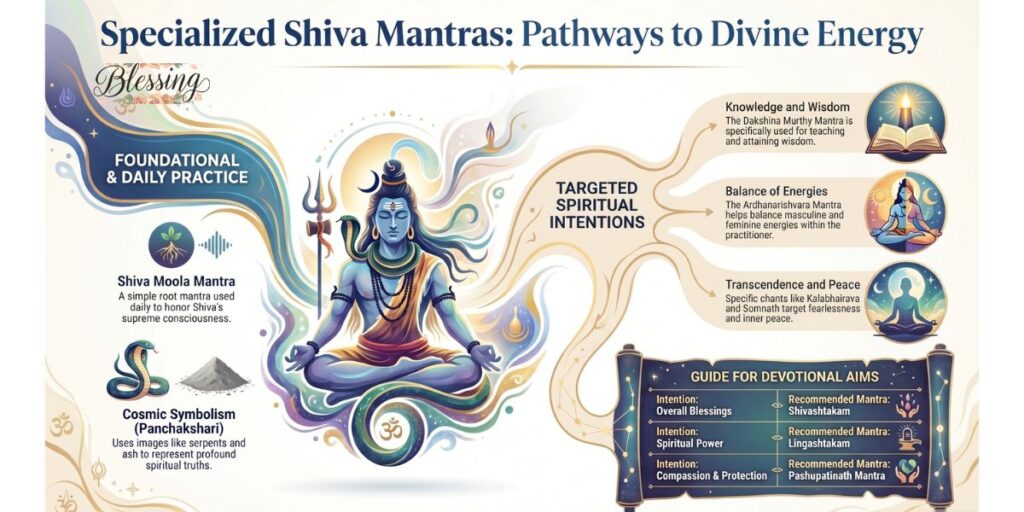
These specialized mantras serve unique spiritual purposes beyond the core practice. Each one carries deep Vedic wisdom and connects you to a specific aspect of Lord Shiva’s energy.
11. Shiva Panchakshari Mantra (Extended)
Sanskrit: नगेन्द्रहाराय त्रिलोचनाय भस्माङ्गरागाय महेश्वराय Transliteration: Nagendraharaya Trilochanaya Bhasmangaraagaya Maheshvaraya Meaning: “To the serpent-garlanded, three-eyed, ash-covered Great Lord.”
This extended mantra deepens your understanding of Shiva’s cosmic symbolism. Each image — serpent, three eyes, ashes — represents a profound spiritual truth.
12. Shiva Moola Mantra
Sanskrit: ॐ श्री महादेवाय नमः Transliteration: Om Sri Mahadevaya Namah Meaning: “Salutations to the great divine Lord.”
A simple, powerful root mantra for daily use. Begin every morning with this — it honors Shiva’s supreme consciousness and sets a devotional tone for the day.
13–21. Regional and Specialized Shiva Mantras
These specialized शिव मंत्र each serve unique spiritual purposes:
- 13. Shivashtakam: Devotional hymn for overall blessings
- 14. Lingashtakam: Honoring the Shiva lingam for spiritual power
- 15. Kalabhairava Mantra: For time transcendence and fearlessness
- 16. Dakshina Murthy Mantra: For knowledge, teaching, and wisdom
- 17. Ardhanarishvara Mantra: For balance of masculine and feminine energies
- 18. Nilakantha Mantra: Honoring Shiva who consumed cosmic poison
- 19. Pashupatinath Mantra: For compassion and protection of all beings
- 20. Kedarnath Mantra: Sacred to the Himalayan Shiva shrine
- 21. Somnath Mantra: Invoking the moon-crested lord for peace
As you deepen your Vedic chanting practice, you will naturally feel drawn to specific mantras that match your current life phase.
Mahadev Mantra for Success: Attracting Abundance Through Devotion
Success and spirituality are not opposites. Shiva mantra for success works by transforming your inner state, your clarity, confidence, and readiness .
So that external results follow naturally. This is what most competitors completely miss: success mantras work from the inside out.
Which Shiva Mantras Work Best for Career Growth
The best mantra for career growth combination uses three layers:
- Om Namah Shivaya Shantaya: builds mental peace for smart decisions
- Om Hreem Namah Shivaya: activates mantra for prosperity consciousness
- Shiva Gayatri: sharpens wisdom for key decision-making moments
Use all three in a single morning sadhana practice session. Rotate focus based on your current need.
Step-by-Step Practice Guide for Success Mantras
Follow this 30-day mantra challenge structure for real results:
Week 1: Foundation:
- Chant Om Namah Shivaya 108 times every morning
- Keep a journal of mindset shifts
- Practice time: 15–20 minutes
Week 2: Amplification:
- Add Om Hreem Namah Shivaya 54 times after main practice
- Visualize yourself already embodying success
- Practice time: 25–30 minutes
Week 3–4: Integration:
- Full 108 repetitions of your chosen Shiva mantra for success
- Take one inspired action daily toward your goal
- Practice time: 30–40 minutes
Real-Life Transformation: How Dedication Brings Results
I personally started chanting Om Namah Shivaya during a difficult career transition. Within three weeks, my mental clarity improved dramatically.
I began noticing opportunities I had previously overlooked. The mantra did not change my circumstances .It changed how I showed up for them.
At BlessInIdeas, we recommend beginning with just 21 repetitions daily and building slowly , consistency matters far more than quantity.
Read More: Celebrities Wearing Karungali Malai: Why Dhanush, Rajinikanth & Samantha Trust This Sacred Mala
How to Chant Mahadev Mantra Correctly: Complete Pronunciation Guide
Correct pronunciation deepens the effectiveness of any Mahadev mantra. This mantra pronunciation guide covers everything a beginner needs to know.
You do not need to be perfect,, sincerity matters most. But learning basics shows respect for the tradition.
Sanskrit Pronunciation Basics for Beginners
Sanskrit is a perfectly phonetic language. Each letter in the Devanagari script has exactly one sound. Master these basics first:
| Vowel | Sound | Example |
|---|---|---|
| A | “u” in “but” | Namah → “Nu-muh” |
| I | “i” in “sit” | Shiva → “Shi-vuh” |
| U | “u” in “put” | Rudra → “Roo-druh” |
| Ah | “a” in “father” | Om → “AUM” |
Key consonants:
- V = between English V and W
- Sh = soft sh as in “Shiva”
- Ya = like “y” in “yes”
Breaking Down Each Syllable (Om Namah Shivaya)
How do you pronounce Om Namah Shivaya? Break it into three parts:
- Om = “AUM” — starts in belly, vibrates in chest, ends with lips closed
- Na-mah = “nu-muh” — the ‘h’ is a soft breath, not silent
- Shi-va-ya = “shi-vuh-yuh” — gentle emphasis on “Shi”
Full rhythm: “AUM… nu-muh shi-vuh-yuh” — breathe between repetitions. Let it flow like a river, not race like traffic.
Common Pronunciation Mistakes to Avoid
Most beginners make these five errors:
- Saying “NAY-mah” instead of “nu-muh”
- Rushing all syllables together without breath
- Ignoring aspirated ‘h’ sounds in Namah
- Chanting in flat, robotic monotone
- Stressing the wrong syllable in “Shivaya”
Pro tip from BlessInIdeas: Listen to recordings from the Isha Foundation on YouTube and chant along for your first week. Your pronunciation will naturally improve without anxiety.
When and Where to Chant Shiva Mantras: Timing and Sacred Spaces
What is the best time to chant Mahadev mantra? The honest answer: whenever you will actually do it consistently. But certain times carry special power.
Best Times of Day (Brahma Muhurta and Beyond)
What is Brahma Muhurta time? It falls approximately 90 minutes before sunrise, around 4:30 to 5:30 AM. The world is still. Your mind is fresh.
Subtle energies are most accessible. Many serious practitioners swear this is the most potent window for any mantra practice.
Other powerful times:
- Sandhya (sunrise and sunset): transition periods mirror inner transformation
- Monday evenings: Monday is Shiva’s sacred day in Hindu tradition
- Maha Shivaratri: the great night of Shiva in February or March — ideal for intensive overnight chanting
Creating Your Sacred Space at Home
A dedicated sacred space home altar charges your practice. You do not need an elaborate temple. Start minimal:
Minimal setup:
- Clean, quiet corner
- Small Shiva image or symbol (optional)
- Cushion or mat to sit on
Upgraded setup:
- Shiva murti or Shiva lingam
- Oil lamp or candle
- Fresh flowers
- Mala beads: preferably rudraksha for Shiva practice
- Incense
The space you practice in daily becomes energetically charged over time. You will feel it.
Can You Chant Anytime, Anywhere? Modern Flexibility
Yes. Ancient practices were designed for ashram life. You live in the modern world. Valid chanting moments include:
- Morning commute (as a passenger)
- Walking in nature
- Lunch break silence
- Washing dishes or routine tasks
- Before sleep as a mantra for sleep practice
Manasika japa, silent mental chanting, is considered more advanced because it demands deeper focus. When you cannot chant aloud, mental repetition works beautifully.
Benefits of Chanting Mahadev Mantra: Mind, Body, and Spirit
Does chanting mantras really work? Yes, and both science and thousands of years of tradition agree. Here is what to expect.
Mental Peace and Stress Relief
Mantra meditation benefits begin in your very first session. The rhythmic repetition of any Shiva mantra activates vagus nerve activation, triggering the parasympathetic nervous system. Your breath slows. Your shoulders drop. Anxious thoughts lose their grip.
A published study confirmed that Om Namah Shivaya chanting significantly reduced depression, anxiety, and stress hormones cortisol in participants within days of practice.
After two to four weeks of consistent daily chanting, stress no longer penetrates as deeply. You are building witness consciousness, the ability to observe your thoughts without being consumed by them.
Read More: How to Wear Karungali Mala: Complete Guide to Benefits, Rules & Rituals (2026)
Spiritual Awakening and Inner Transformation
Long-term mantra for spiritual growth practice creates shifts that go beyond words. Practitioners describe spontaneous moments of deep peace.
A growing sense of connection to something vast. Natural compassion arising without effort. These experiences align with what ancient Vedic teachings call spiritual awakening, not a dramatic event but a gradual remembering of your true nature.
Physical Health Benefits (Scientific Perspective)
Research on mantra meditation benefits shows measurable physical changes:
- Reduced cortisol and lower blood pressure in hypertensive patients
- Alpha and theta brain wave changes meditation (deep relaxation states)
- Improved heart rate variability and immune function
- Better sleep quality when practiced in the evening
Important: Mantras are not medicine. They complement healthcare. They do not replace it. Always consult qualified medical professionals for serious health conditions.
Protection and Positive Energy
Many practitioners report that after beginning regular protection mantra Shiva practice, negative people and situations naturally drift away. This is not superstition.
Your changed internal state, lower stress, greater clarity, stronger boundaries, changes how you interact with the world. The Vasudhaiva Kutumbakam principle (“all the world is family”) reminds us that our inner state ripples outward.
Can Non-Hindus Chant Mahadev Mantra? Breaking Down Barriers
Can non-Hindus chant Shiva mantras? Absolutely yes. Here is why — and what the tradition actually says.
Traditional Perspective on Universal Spirituality
The Vedas declare Vasudhaiva Kutumbakam, the whole world is one family. Sanskrit is called Devanagari, the language of the gods.Because its sounds predate any single religion.
The concept of shabda brahman teaches that these sound vibrations ARE the divine, not symbols of it. They belong to consciousness itself, not to any one group.
Modern Inclusive Approach
Non-Hindu chanting Shiva is fully supported by contemporary spiritual teachers. Swami Vivekananda taught that spirituality is realization, not label.
The Isha Foundation welcomes people of all backgrounds into mantra practices without requiring conversion or belief changes. What matters is sincerity, respect, and willingness to honor the tradition.
What Matters Most: Intention Over Identity
The divine responds to your inner state, not your passport or religion. Regarding cultural appropriation spirituality: the key distinction is appreciation versus appropriation.
Appreciation means learning with humility, honoring origins, and practicing sincerely. If you are reading this guide carefully, studying pronunciation, and seeking to understand, you are doing it right.
Beginner’s Journey: Your First 30 Days With Shiva Mantras
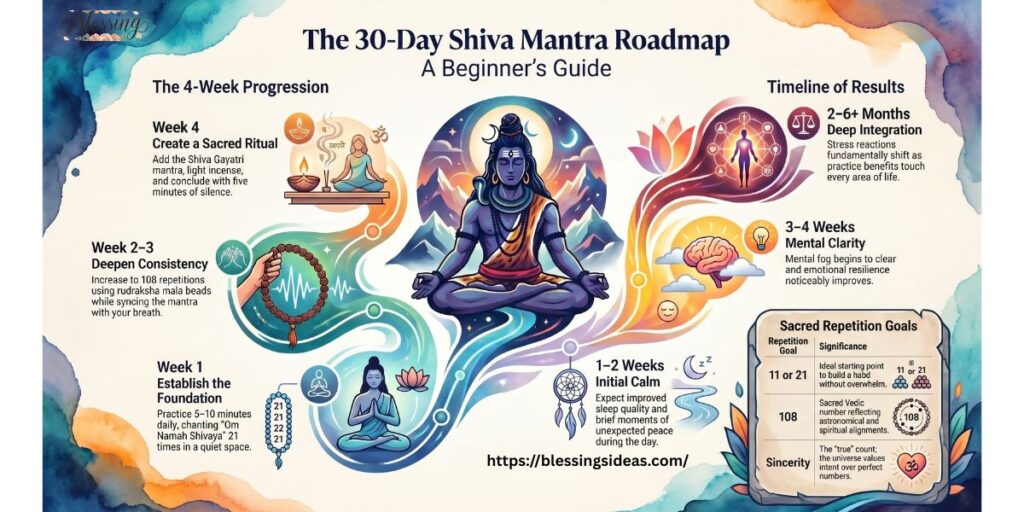
How do I start a mantra practice? Follow this 30-day mantra challenge roadmap. Keep it simple. Build it slow.
Week 1: Starting Simple (Days 1–7)
Daily practice — 5 to 10 minutes:
- Find a quiet corner (your future sacred space home altar)
- Sit comfortably — chair or floor, it does not matter
- Take three slow breaths
- Chant Om Namah Shivaya 21 times
- Sit in silence for one minute
Day 1 will feel strange. Day 4 is when most people want to skip. Do it anyway — even 11 repetitions counts. By Day 7, your body will anticipate the practice.
Week 2–4: Building Consistency and Depth
Week 2: Increase to 54 or 108 repetitions. Add mala beads (rudraksha preferred). Notice when your mind wanders — this noticing IS the practice.
Week 3: Sync mantra with breath. Inhale: “Om Namah” — exhale: “Shivaya.” Try manasika japa (silent mental chanting) on alternate days.
Week 4: Add one more mantra — the Maha Mrityunjaya mantra or Shiva Gayatri. Create a small ritual: light incense, set clear intention, end with five minutes of silence.
What to Expect: Realistic Timelines for Results
How long before mantra chanting shows results?
| Timeline | What You May Notice |
|---|---|
| First session | Slight relaxation, slower breath |
| 1–2 weeks | Better sleep, moments of unexpected calm |
| 3–4 weeks | Emotional resilience improving, mental fog clearing |
| 2–3 months | Reactions to stress fundamentally shift |
| 6+ months | Deep integration, benefits touch every life area |
Be patient. Be consistent. Results come from mantra repetition — not from perfection.
Common Questions About Chanting (Troubleshooting Guide)
What If I Can’t Focus While Chanting?
Use mala beads to give your hands a job. Link mantra to breath. Chant out loud when mental focus fails. Shorter, more frequent sessions beat one long distracted session every time.
Is Digital Chanting (Apps/Videos) as Effective?
Mantra apps effectiveness is real for learning pronunciation and maintaining rhythm. But your own voice generates the vibration that matters most.
Use recordings to learn, then practice independently. Background Vedic chanting audio is ambient energy, not practice.
How Many Times Should I Repeat Each Mantra?
Why is 108 sacred in Hinduism? The number 108 appears throughout Vedic tradition: 108 Upanishads, 108 names of deities and the astronomical relationship between Earth, Sun, and Moon. But start with 11 or 21 if 108 feels overwhelming. The universe counts your sincerity, not just your numbers.
Frequently Asked Questions
What is the most powerful Mahadev mantra?
Om Namah Shivaya is the most universal — the Maha Mrityunjaya mantra is the most powerful for healing and protection.
Can I chant Shiva mantras without a guru?
Yes. Mantras like Om Namah Shivaya are open to all. Mantra without initiation guru is fully valid — sincere devotion is enough.
Can I chant mantras on my period?
Yes. Personal devotion has no such restriction. The divine does not recognize the body’s natural cycles as impure — many contemporary spiritual teachers confirm this fully.
What mantra helps with anxiety and stress?
Om Shantih Shantih Shantih for immediate calm. Om Namah Shivaya for long-term mantra for anxiety relief through daily practice.
What does Mahadev mean in English?
“Mahadev” means “Great God” — “Maha” = great, “Dev” = God or deity. It is one of the most revered names of Lord Shiva in Hindu tradition.
Conclusion
Mahadev mantras are among the most powerful spiritual tools ever created. From the universal Om Namah Shivaya to the transformative Maha Mrityunjaya mantra, each chant opens a doorway to inner peace, clarity, and spiritual growth. Science confirms what ancient sages always knew: Sanskrit chanting rewires your nervous system, reduces stress hormones cortisol, and shifts your brain wave changes meditation patterns toward deeper calm.

Alich, a skilled content writer with 3+ years of experience, known for creating clear guides and 1000+ published articles across multiple niches.