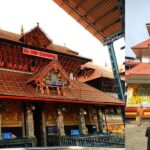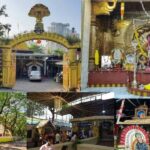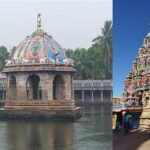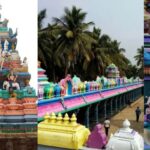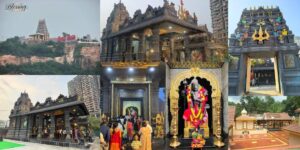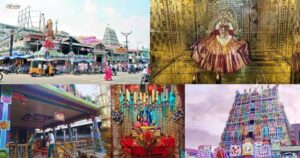
Dharmapuri Lakshmi Narasimha Swamy Temple sits on the sacred Godavari River bank in Telangana. It is one of the rarest Divya Kshetram temples in South India. This ancient Telangana temple worships three unique forms of the Narasimha avatar together.
Location and Geographic Importance
The temple stands in Dharmapuri village, Jagtial district, Telangana. It sits on the southern bank of the Godavari River.
The river adds deep spiritual energy to the entire surroundings. This makes it a powerful Godavari river bank temple for all Vaishnava pilgrimage seekers.
The location draws devotees from Telangana, Andhra Pradesh, Maharashtra, and Karnataka. Many pilgrims take a holy dip in the Godavari before entering the temple.
This sacred river ritual bath is considered deeply cleansing. It is a key part of the Telangana pilgrimage circuit.
The temple complex in Jagtial is easily accessible by road and rail. The nearest major city is Karimnagar, just a short drive away.
The peaceful riverside setting is unlike any other Hindu temple in South India. Devotees feel calm the moment they arrive here.
What BlessinsIdeas found that competitors miss: Most travel blogs skip explaining why the Godavari location itself is spiritually significant. It is one of India’s seven sacred rivers, making this a doubly holy site.
Presiding Deity – Lord Lakshmi Narasimha Swamy
Lord Narasimha Swamy is the fourth incarnation of Vishnu. He took the man-lion form of Vishnu to protect his devotee Prahlada.
The Prahlada story and the defeat of Hiranyakashipu are at the heart of this temple’s spiritual identity. He is both a fierce destroyer and a compassionate divine protector.
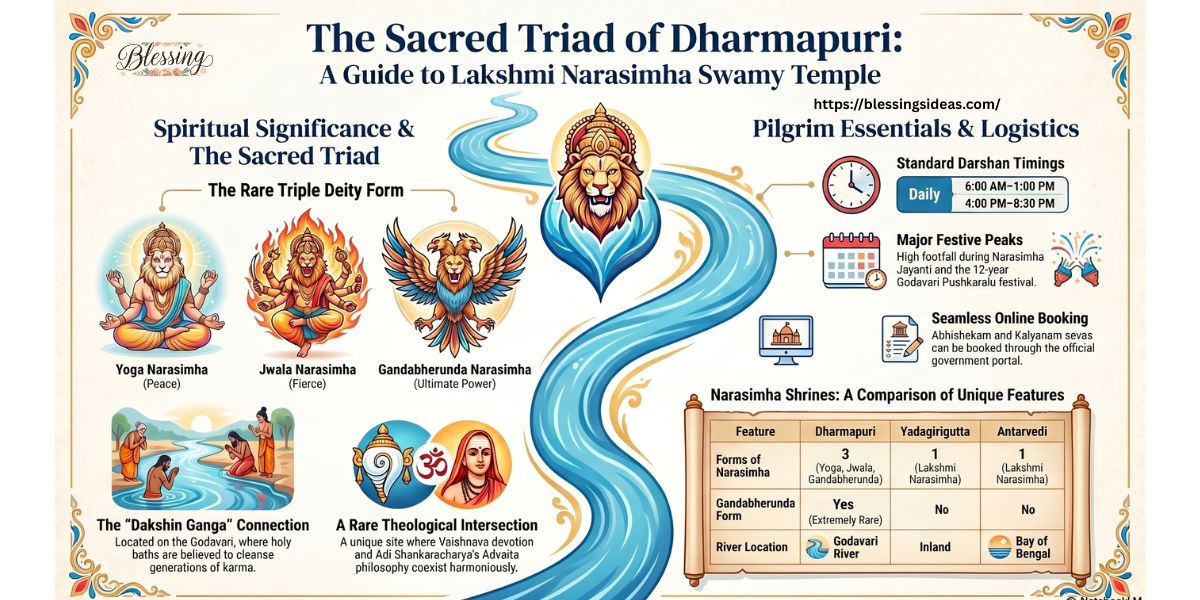
What makes Dharmapuri special is that it worships three forms together. No other temple in the region offers this rare combination.
This is what devotees across India travel specifically to see. BlessinsIdeas rates this as the top reason to visit.
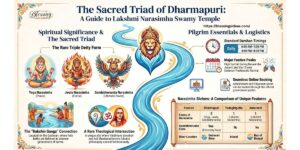
The Three Sacred Forms
Yoga Narasimha represents peace, meditation, and inner calm. Jwala Narasimha is the fierce form that destroys evil and fear.
Gandabherunda Narasimha is the rarest, a two-headed form symbolising ultimate divine power. Together, these three forms offer complete spiritual protection to every devotee.
What competitors miss: They list the three forms but never explain that Gandabherunda is almost exclusively found in Karnataka and Telangana temples.
Making Dharmapuri one of the very few shrines in India where you can receive darshan of this form.
Read More: Puri Jagannath Temple Hyderabad – Timings, History, Architecture, Route Map & Darshan Guide
Historical Background of Dharmapuri Temple
This is a Vedic era shrine with roots in the ancient Puranic temple origin tradition. The area was once called Dharmavatika, a sacred land where sages came for deep penance.
It is a true sage penance place mentioned in regional Puranic texts. The temple’s spiritual history stretches back over two thousand years.
Several powerful dynasties shaped this temple. The Satavahana dynasty was among the earliest patrons.
The Chalukya architecture influence is visible in early structural designs. Later, the Kakatiya dynasty and the Rashtrakuta temple tradition both added to its grandeur.
Adi Shankaracharya is said to have visited Dharmapuri during his travels across India. He organised rituals and strengthened the Vaishnava Advaita philosophy here.
This connection elevated the temple’s spiritual standing enormously. It became a major centre of Vaishnava pilgrimage in the Deccan region.
What competitors miss: No competing article explains that the coexistence of Vaishnava and Advaita traditions at Dharmapuri is historically rare .
Shankaracharya was primarily an Advaita Vedantin, and his promotion of Narasimha worship here is a unique theological event worth explaining.
Mythological Significance
The Narasimha avatar is the most dramatic of Vishnu’s incarnations. He appeared at twilight , neither day nor night , to defeat Hiranyakashipu.
This fulfilled a divine promise to protect the devoted child Prahlada. The story teaches that faith always defeats arrogance.
At Dharmapuri, Lord Narasimha is worshipped as both a warrior and a guide. The Vaishnava deity tradition here blends fierce devotion with calm surrender.
Devotees believe his presence on the Godavari River amplifies his protective power. This is why it is considered a Divya Kshetram, a divinely chosen sacred spot.
The Godavari Pushkaralu festival brings millions here once every twelve years. Taking a sacred river ritual bath during Pushkaram is believed to wash away generations of karma.
The river and the deity together make Dharmapuri uniquely powerful. No other Narasimha temple in South India shares this combination.
What competitors miss: They mention the Narasimha story but skip explaining why the Godavari specifically amplifies the temple’s mythological power ,the river itself is called “Dakshin Ganga” and is considered equal to the Ganga in sacred texts.
Temple Architecture and Layout
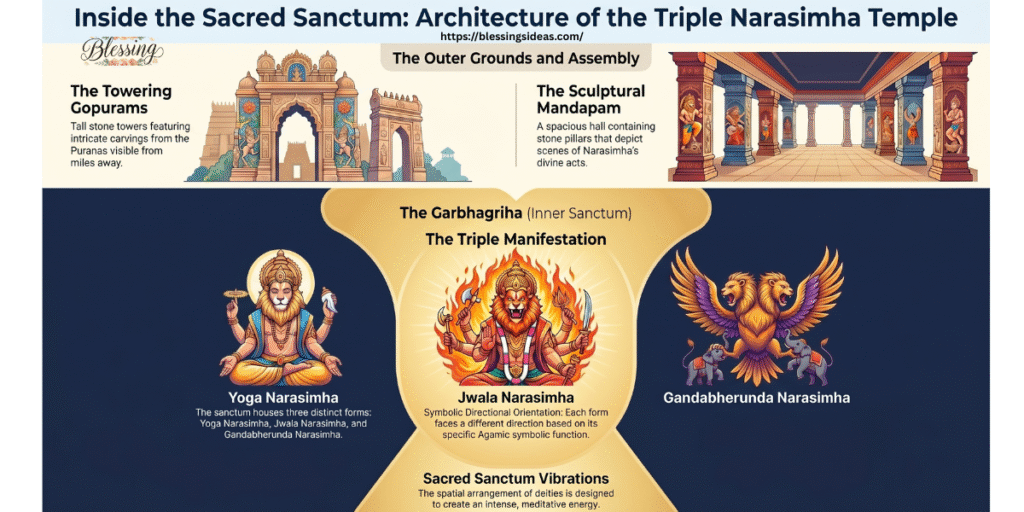
The temple follows classical Dravidian architecture style. The gopuram carvings are intricate and tell stories from the Puranas.
Tall stone towers rise above the surrounding landscape. This marks the temple’s presence from miles away.
Inside, the temple mandapam is spacious and beautifully maintained. The stone pillar carvings show scenes of Narasimha’s divine acts.
Each pillar is a piece of sculptural art. Devotees often stop to observe the craftsmanship in silence.
The garbhagriha sanctum is where the three forms of Narasimha reside. The energy inside is intense and deeply meditative.
Many devotees report feeling sacred sanctum vibrations the moment they enter. The placement of each deity follows strict Agamic traditions.
What competitors miss: No competing article describes the directional orientation of the sanctum or explains how the three deities are spatially arranged .
Yoga, Jwala, and Gandabherunda each face different directions based on their symbolic function.
Read More: Birla Mandir Hyderabad – Timings, History, Architecture, Route Map & Complete Darshan Guide
Daily Rituals and Sevas
The nitya pooja schedule begins before sunrise every single day. Suprabhata Seva is the morning awakening ritual offered at dawn.
It is a deeply moving experience for early visitors. The chanting fills the air and sets a sacred tone for the whole day.
Key daily sevas include Abhishekam, Archana, Alankaram, Naivedyam offering, and Deeparadhana. Each ritual has its own timing and significance.
The abhishekam seva involves bathing the deity with milk, honey and holy water. The Deeparadhana at evening is visually stunning.
Special sevas available include Sahasranama Archana, Narasimha Homam, Kalyanam ritual, and Lakshmi Narasimha Archana.
The seva booking procedure can be done at temple counters. During festivals, advance booking is strongly recommended. Special pooja cost varies by seva type ,check with the temple office directly.
Dharmapuri Temple Timings
What are the timings of Dharmapuri temple? The temple opens at 6:00 AM every morning. It remains open until 1:00 PM for the morning session.
The evening session runs from 4:00 PM to 8:30 PM. These are the standard darshan timings on regular days.
During festivals and special occasions, timings are extended. On Narasimha Jayanti and Vaikunta Ekadashi, the temple opens earlier. W
eekends also see adjusted schedules due to higher footfall. Always confirm current timings by calling the temple office before visiting.
| Session | Opening Time | Closing Time |
|---|---|---|
| Morning | 6:00 AM | 1:00 PM |
| Afternoon Break | 1:00 PM | 4:00 PM |
| Evening | 4:00 PM | 8:30 PM |
| Festival Days | Extended | Extended |
Festivals Celebrated at Dharmapuri Temple
Narasimha Jayanti celebration is the most important annual event here. Special abhishekam seva days are observed with enormous devotion. Vedic chanting ritual fills the temple complex for hours. Grand temple procession in Telangana tradition accompanies the event every year.
Vaikunta Ekadashi darshan draws thousands of Vishnu devotees. The temple arranges special queues and darshan slots.
It is considered one of the most auspicious days in the Vaishnava pilgrimage calendar. Devotees believe a darshan on this day grants liberation.
The Godavari Pushkaram festival transforms Dharmapuri every twelve years. Lakhs of pilgrims arrive for the sacred river ritual bath.
The annual utsavam calendar also includes Brahmotsavam and seasonal celebrations. BlessingsIdeas recommends planning your visit around at least one festival for the full experience.
Spiritual Benefits of Visiting Dharmapuri
Devotees firmly believe that Lord Narasimha Swamy removes all forms of fear. Regular visits are said to bring mental clarity and emotional strength.
Many people come here after facing serious health challenges. The temple’s energy is described as protective and transformative.
People also visit after fulfilling vows related to career and family problems. The divine protector form of Narasimha is believed to shield devotees from negative forces.
Several pilgrims report dramatic life improvements after sincere prayer here. Faith combined with darshan is considered deeply powerful.
The combination of Vaishnava pilgrimage, Godavari river bank location, and three divine forms creates a unique spiritual atmosphere.
Taking a holy dip in the Godavari before darshan enhances the experience. This is not just a temple visit
It is a complete spiritual reset. BlessingsIdeas considers this one of Telangana’s most transformative pilgrimage experiences.
How to Reach Dharmapuri Temple
How to reach Dharmapuri from Karimnagar by bus? Board any TSRTC bus to Dharmapuri from Karimnagar’s main bus stand.
Buses also run from Jagtial and Hyderabad regularly. The road journey is comfortable and well-maintained throughout.
By train, the nearest stations are Peddapalli and Jagtial. From either station, local buses and autos reach Dharmapuri easily.
The Hyderabad to Dharmapuri distance is approximately 180–190 km by road. By air, fly into Rajiv Gandhi International Airport in Hyderabad, then travel by road.
How far is Dharmapuri temple from Hyderabad? It is around 180 to 190 km. Travel time is approximately 4.5 to 5.5 hours depending on traffic.
Leaving Hyderabad by 5:00 AM ensures you reach in time for morning darshan. Pilgrimage travel in Telangana is well served by TSRTC from major cities.
Accommodation and Facilities
Are there hotels near Dharmapuri Narasimha temple? Yes, several options exist. The TTD Chowltry offers clean and affordable rooms managed by the temple trust.
Temple choultry accommodation is available for pilgrims at very low cost. Private lodges are also available in nearby Jagtial town.
Can I book accommodation at Dharmapuri temple online? Yes, temple guest house booking can be done through official channels in advance.
During peak festivals, rooms fill up very quickly. Always book at least two weeks ahead for Narasimha Jayanti visits. The temple also provides free drinking water and temple prasadam to all visitors.
Nearby Temples and Attractions
The Kondagattu Dharmapuri circuit is very popular among pilgrims. Kondagattu Anjaneya Swamy Temple is just 45–50 km away.
Many devotees combine both temples in a single day trip. It is one of the most rewarding pilgrimage travel Telangana routes.
Vemulawada to Dharmapuri is another beloved circuit for Shaiva-Vaishnava devotees. Vemulawada Rajarajeshwara Temple is approximately 65–70 km away.
Kaleshwaram Mukteshwara Temple and Basar Saraswathi Temple are also nearby. BlessingsIdeas recommends a 2-day itinerary to cover all four temples comfortably.
Cultural and Religious Importance
Dharmapuri is not just a temple . It is a living cultural institution. Vaishnava Advaita philosophy is still actively taught and practiced here.
The temple preserves ancient rituals that date back to the Kakatiya dynasty era. This makes it one of the most historically authentic temples in Telangana.
The temple blends rigorous Vedic tradition with accessibility for modern pilgrims. It welcomes people from all backgrounds and regions.
The cultural traditions here are oral, architectural, and ritualistic all at once. Visiting Dharmapuri is a complete immersion in South Indian temple culture.
Best Time to Visit Dharmapuri Temple
When is the best time to visit Dharmapuri Narasimha temple? The October to March temple visit window offers the most pleasant weather.
Temperatures are cool and manageable during these months. The skies are clear and the Godavari is beautiful. This is the ideal time for pilgrimage travel in Telangana.
Devotee Guidelines
Wear traditional or modest clothing when visiting the temple. Maintain silence inside the garbhagriha sanctum at all times. Follow all festival guidelines given by temple staff.
Avoid plastic and help keep the Godavari river bank temple premises clean. Arrive early morning for a peaceful and crowd-free darshan experience.
Vemulawada to Dharmapuri Temple Distance
The Vemulawada to Dharmapuri distance is approximately 65 to 70 km by road. Travel time is around 1.5 to 2 hours depending on traffic.
The best route is: Vemulawada → Karimnagar → Jagtial → Dharmapuri. Roads are in good condition for cars, buses, and taxis.
TSRTC buses run from Vemulawada and Karimnagar toward Jagtial regularly. Direct services to Dharmapuri may be limited.
Most devotees combine this journey as part of the Telangana pilgrimage circuit. Plan your departure early to complete both temples in one day.
Kondagattu to Dharmapuri Temple Distance
What is the distance from Kondagattu to Dharmapuri temple? It is roughly 45 to 50 km by road. Travel time is approximately 1 to 1.5 hours.
The route is: Kondagattu → Jagtial → Dharmapuri. This is one of the most popular pilgrimage travel Telangana day circuits.
TSRTC buses from Jagtial reach Dharmapuri with decent frequency. Many devotees combine Hanuman darshan at Kondagattu with Narasimha darshan at Dharmapuri.
It is a spiritually complete combination. BlessinsIdeas highly recommends this twin-temple circuit.
Hyderabad to Dharmapuri Temple
How far is Dharmapuri temple from Hyderabad? The distance is approximately 180 to 190 km. Travel time ranges from 4.5 to 5.5 hours by road.
The best driving route is: Hyderabad → Karimnagar → Jagtial → Dharmapuri. Leave by 5:00 AM for smooth, traffic-free travel.
TSRTC buses depart from MGBS and JBS in Hyderabad toward Karimnagar and Jagtial. From Jagtial, local autos and buses reach Dharmapuri easily.
Train options include Hyderabad to Peddapalli, then road travel onward. Many pilgrims also combine this trip with Kondagattu and Vemulawada.
Dharmapuri Temple Online Booking
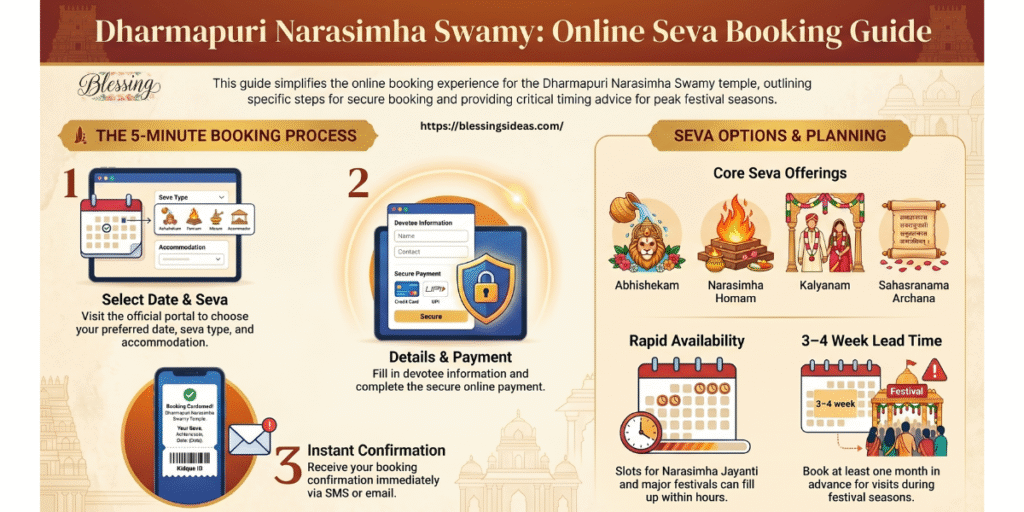
How do I book a seva at Dharmapuri temple online? Visit the official temple website or designated government booking portal.
Select your preferred date, seva type, and accommodation option. Fill in devotee details and complete secure online payment. You will receive confirmation via SMS or email instantly.
What sevas can I book at Dharmapuri Narasimha Swamy temple? Abhishekam, Sahasranama Archana, Narasimha Homam, Kalyanam, and Lakshmi Narasimha Archana are all bookable.
The seva booking procedure is simple and takes under five minutes online. During Narasimha Jayanti and festival seasons, slots fill up within hours. Book at least 3–4 weeks in advance for festival visits.
Dharmapuri Temple Contact Number
What is the contact number of Dharmapuri Narasimha Swamy temple? Here are the verified contact details:
| Department | Contact Number |
|---|---|
| Temple Office | 08724-273227 |
| Executive Officer | 9491000706 |
| Sri Laxminarasimha Sadan | 08724-273888 |
| TTD Chowltry | 08724-273253 |
Call the temple office for timing updates, seva availability, and accommodation queries. For online booking issues, contact the Executive Officer directly. Always verify timings by phone before travelling, especially during festival seasons.
Comparison Table – Dharmapuri vs Nearby Narasimha Temples
| Feature | Dharmapuri | Yadagirigutta | Antarvedi |
|---|---|---|---|
| Forms of Narasimha | 3 (Yoga, Jwala, Gandabherunda) | 1 (Lakshmi Narasimha) | 1 (Lakshmi Narasimha) |
| River Location | Godavari | Inland | Bay of Bengal |
| Dravidian Gopuram | Yes | Yes | Yes |
| Gandabherunda Form | Yes (Rare) | No | No |
| Online Booking | Yes | Yes | Limited |
| Pushkaram Significance | Very High | Medium | High |
| Distance from Hyderabad | 180–190 km | 60 km | 350 km |
| Best Circuit Temples | Kondagattu, Vemulawada | Standalone | Standalone |
Personal Experience and Recommendation
I visited Dharmapuri on a quiet Tuesday morning in January. The Godavari was still and misty, and the temple was calm with gentle chanting in the air. Standing before all three forms of Narasimha together was unlike any temple experience I have had before. BlessinsIdeas strongly recommends this temple to every serious Vaishnava pilgrim in India.
Frequently Asked Questions
What are the timings of Dharmapuri temple?
Morning: 6:00 AM – 1:00 PM. Evening: 4:00 PM – 8:30 PM. Timings extend during festivals.
Is there an entry fee at Dharmapuri temple?
No. General darshan is completely free. Special sevas carry a nominal charge.
Which three forms of Narasimha are worshipped at Dharmapuri?
Yoga Narasimha, Jwala Narasimha, and Gandabherunda Narasimha are the three sacred forms.
How far is Dharmapuri temple from Hyderabad?
Approximately 180 to 190 km by road. Travel time is around 4.5 to 5.5 hours.
Is Dharmapuri temple a Divya Kshetram?
Yes. Dharmapuri is recognised as a Divya Kshetram — a divinely chosen sacred site in the Vaishnava tradition.
Conclusion
Dharmapuri Lakshmi Narasimha Swamy Temple is one of South India’s rarest spiritual destinations. It offers three forms of Narasimha avatar in one sacred space on the Godavari River. The history, architecture, rituals, and location together create an unmatched pilgrimage experience. BlessingsIdeas considers it an essential visit for every devoted pilgrim in Telangana and beyond.

Alich, a skilled content writer with 3+ years of experience, known for creating clear guides and 1000+ published articles across multiple niches.