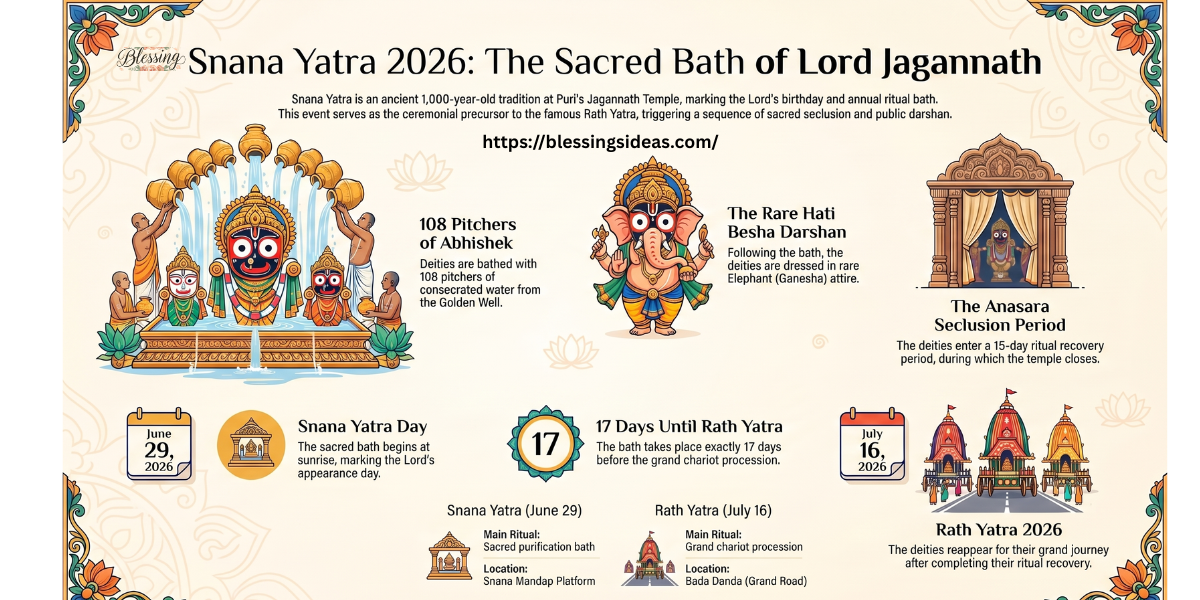
Snana Yatra 2026 falls on June 29 at Jagannath Temple Puri Odisha. It is the sacred ceremonial bathing festival of Lord Jagannath. BlessingsIdeas brings you the complete guide to this holy event.
What Is Snana Yatra?
Snana Yatra is the annual sacred bathing festival of Lord Jagannath, Lord Balabhadra, and Goddess Subhadra.
It is observed on the Jyeshtha Purnima full moon day every year at Srimandir Puri. This festival is also called Deva Snana Purnima or Snana Purnima. It marks the first public darshan of the year for millions of devotees across the world.
The festival takes place at the Snana Mandap bathing platform inside Jagannath Temple Puri.
The deities are brought out from the inner sanctum in a grand procession. Devotees from all faiths, including non-Hindu visitors, are allowed to witness the ceremony.
This makes Snana Yatra one of the most inclusive events in the entire Odia Hindu festival calendar.
According to the Skanda Purana Jagannath, this day is the appearance day (birthday) of Lord Jagannath.
The Skanda Purana, one of the 18 major Hindu Puranas, declares Jyeshtha Purnima as his most sacred day.
Every year, lakhs of devotees gather to witness this divine event. BlessingsIdeas considers this one of the most important Vaishnava festival rituals in India.
The ceremonial bathing festival Hindu tradition here is deeply connected to Rath Yatra 2026.
Snana Yatra begins the sacred festival sequence. It triggers the Anasara period, then Netrotsav, and finally Rath Yatra. Understanding this sequence helps every devotee and traveler plan their visit better.
Snana Yatra 2026: Date, Timings & Calendar
When is Snana Yatra in 2026? The answer is simple. Snana Yatra 2026 falls on June 29, 2026. The Jyeshtha Purnima full moon tithi begins on the afternoon of June 28 and continues through June 29. The bathing rituals begin shortly after sunrise on June 29, 2026.
Here is the complete 2026 festival calendar to help you plan your Odisha religious tourism trip:
| Event | 2026 Date | Key Detail |
|---|---|---|
| Snana Yatra (Deva Snana Purnima) | June 29, 2026 | First public darshan of the year |
| Hati Besha (Elephant Attire) | June 29, 2026 (Afternoon) | Rare Ganesha-form darshan |
| Anasara Period Begins | June 29, 2026 (Evening) | Temple closes for 15 days |
| Temple Reopens (Netrotsav) | ~July 14–15, 2026 | Nava Yovana Darshan |
| Rath Yatra 2026 | July 16, 2026 | Grand chariot procession |
| Bahuda Yatra (Return Journey) | July 24, 2026 | Deities return from Gundicha Temple |
Is Jagannath Temple open on June 29, 2026? Yes, it is open for Snana Yatra darshan. The main sanctum closes that same evening when the Anasara period begins.
Plan your arrival carefully. BlessingsIdeas recommends arriving by June 27 to secure good accommodation near the temple.
How many days before Rath Yatra is Snana Yatra? In 2026, Snana Yatra on June 29 comes exactly 17 days before Rath Yatra 2026 on July 16.
This gap is traditionally 15 to 18 days. It is filled by the Anasara period and the Netrotsav / Nava Yovana Darshan ceremony.
History & Origins of Snana Yatra
Snana Yatra is one of the oldest living religious traditions in India. Its scriptural roots go back to the Skanda Purana Jagannath passages describing this sacred bathing rite.
The festival has been observed continuously for over a thousand years. Poet-saint Jayadeva, who composed the Gita Govinda Jayadeva at Srimandir Puri in the 12th century CE, was part of this living tradition.
The Legend of King Indradyumna
The King Indradyumna legend is the foundation of Snana Yatra. According to tradition, King Indradyumna was the first ruler to establish the Jagannath Temple Puri Odisha.
He initiated the ritual of Snana Yatra after the deities were installed. The three sacred wooden forms of Lord Jagannath, Lord Balabhadra, and Goddess Subhadra were carved from a sacred neem log called Daru Brahma neem log.
The mysterious carpenter who carved them was believed to be Vishwakarma divine carpenter in disguise.
Read More: Visakha Utsav 2026 Dates, Venue, Timings & Full Guide for Visitors
The Ganapati Bhatta Legend & Hati Besha
The Ganapati Bhatta legend is one of the most touching stories in the entire Jagannath tradition.
A devoted pilgrim named Ganapati Bhatta devotee had one deep desire. He longed to see Lord Jagannath in the elephant form of Lord Ganesha.
His devotion was so pure that the Lord fulfilled his wish during Snana Yatra. This is the origin of the celebrated Hati Besha darshan tradition, which continues every year without fail.
Snana Yatra Rituals: A Step-by-Step Guide
The Snana Yatra rituals follow a strict sacred sequence. Each step carries deep spiritual meaning.
The Bada Pandas hereditary priests of the temple oversee the entire ceremony. Here is the complete step-by-step guide that BlessingsIdeas has compiled for devotees and visitors.
Step 1 — Pahandi Vijay Procession: The deity procession Pahandi Vijay happens on the day before Snana Yatra.
The Bada Pandas hereditary priests carry the deities in a rhythmic, swaying walk. Conch shells, cymbals, and devotional music fill the air. The deities reach the Snana Bedi / Snana Mandap for public darshan.
Step 2 — Mangal Arati: The Bada Pandas perform the sacred opening prayer before dawn. This marks the formal ceremonial beginning of the festival.
It is one of the most serene moments of the entire day. Devotees gather in silence to witness this auspicious ritual.
Step 3 — Sacred Water from Suna Kua Golden Well: Water is drawn from the Suna Kua Golden Well inside the temple.
The Suara and Mahasuara clans draw the water with veiled mouths to maintain ritual purity. The water is then enriched with herbs and sandalwood paste.
It is consecrated through sacred water Vedic mantras before being poured into 108 pitchers.
Step 4 — The 108 Pitchers Abhishek: This is the central moment of Snana Yatra. Each deity including Lord Jagannath, Lord Balabhadra, Goddess Subhadra, Sudarshana Chakra, and Madana-mohana is bathed with exactly 108 pitchers abhishek of consecrated water.
The number 108 represents cosmic completeness in Vaishnava tradition. This scene is breathtaking and deeply moving for all who witness it.
Step 5 — Sada Besha: After the bath, the deities are dressed in simple white attire called Sada Besha.
This symbolizes purity and the freshly cleansed divine form. It is a quiet, beautiful moment after the grand bathing ceremony.
Step 6 — Hati Besha: In the afternoon, the elephant attire Ganesha form is placed on Lord Jagannath and Lord Balabhadra.
This is the celebrated Hati Besha darshan. It is available to the public for only a few hours. Arrive early to witness this once-a-year sight.
Step 7 — Sahanamela Evening Darshan: In the evening, devotees are granted open public darshan called Sahanamela.
This is the last public darshan before the Anasara period begins. Thousands crowd the Snana Mandap bathing platform for a final glimpse of their Lord. The atmosphere is deeply emotional and spiritually charged.
Hati Besha: Lord Jagannath’s Rare Elephant Attire
What is Hati Besha? It is the sacred elephant attire Ganesha form worn by Lord Jagannath and Lord Balabhadra on Snana Purnima afternoon.
Large elephant ears, a trunk, and full Ganesha iconography adorn the deities. Goddess Subhadra is dressed in a corresponding floral attire. This darshan happens only once a year.
Hati Besha darshan is one of the rarest moments in the entire Odia Hindu festival calendar. It is also one of the few darshans where non-Hindu visitors allowed to witness the deities up close.
The Snana Mandap bathing platform is open and elevated, visible from outside the main temple.
BlessingsIdeas strongly encourages every devotee to witness this at least once in their lifetime.
Why Hati Besha?
The tradition comes directly from the Ganapati Bhatta legend. His pure devotion moved Lord Jagannath to appear in the elephant Ganesha form.
This divine act of grace , the Lord becoming whatever form his devotee desires, is the heart of Bhakti. The tradition has been observed every single year since that day.
Read More: Gudi Padwa 2026 – Date, Puja Muhurat, Panchang & Celebration Guide
The Anasara Period: Why the Jagannath Temple Closes After Snana Yatra
Why does Jagannath Temple close after Snana Yatra? After the bathing ceremony, the deities are believed to have fallen ill.
They enter a ritual seclusion 15 days period called the Anasara period. The main sanctum of Jagannath Temple Puri closes completely. The deities rest in the Anasara Pindi sacred sick room, attended by temple physicians.
What Devotees Do During Anasara
What do devotees do during Anasara? Devotees worship the Pattachitra Anasara Pata , a sacred painted cloth representing the resting deities.
Pilgrims in Puri may visit the Alarnath Temple Brahmagiri during this period, where Lord Vishnu is said to reside.
ISKCON Snana Yatra programmes and special kirtans are held worldwide. This period deepens the spiritual practice called viraha bhakti , the devotion born of separation.
The Anasara Pata — A Living Art Form
The Pattachitra Anasara Pata is a sacred art form, not merely a substitute. Master painters called Chitrakars create these cloth paintings following ancient iconographic rules.
The Pattachitra tradition of Odisha is one of the oldest living art traditions in India. Worshipping the Anasara Pata during this 15-day period is considered deeply auspicious.
What Happens When Anasara Ends?
When does Jagannath Temple reopen after Snana Yatra? The temple reopens around July 14–15, 2026 with the Netrotsav / Nava Yovana Darshan ceremony.
Temple servitors apply fresh kajal to the deities’ eyes and adorn them in new sacred attire. This moment is called Nava Yovana Darshan , the sight of the eternally youthful Lord. The very next day, Rath Yatra 2026 on July 16, 2026 begins.
Spiritual Significance of Snana Yatra
Snana Yatra carries profound spiritual meaning for the Vaishnava festival rituals tradition. It is not simply a ritual bath , it is a cosmic act of love.
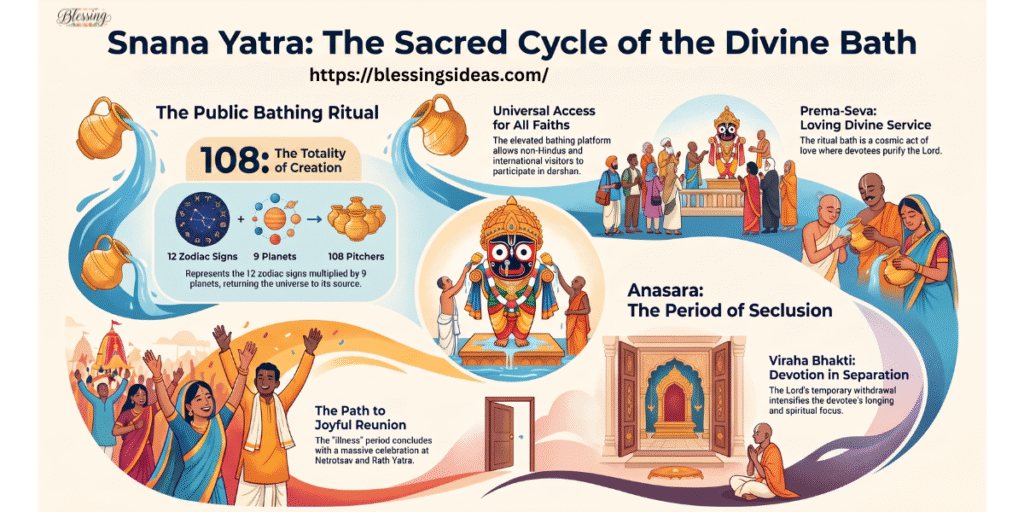
Devotees offer 108 pitchers abhishek to the Lord as an act of prema-seva, meaning loving divine service.
BlessingsIdeas sees this as one of the most beautiful expressions of devotion in all of Hinduism.
Purification & the Divine Cycle
The purification divine cycle of Snana Yatra teaches a deep truth. The devotee purifies the Lord , an inversion of normal worship.
The number 108 is not accidental. In Vaishnava festival rituals, 108 represents the totality of creation: 12 zodiac signs multiplied by 9 planets.
Bathing the Lord with 108 pitchers abhishek symbolically returns the entire universe back to its source.
A Festival of Universal Access
Can non-Hindus attend Snana Yatra? Yes, absolutely. The Snana Mandap bathing platform is elevated and open, visible from outside the inner sanctum.
No entry into the restricted main temple is required. This is one of the few moments where temple darshan public access extends to people of all faiths and nationalities.
This inclusivity reflects the message that Lord Jagannath , the Lord of the Universe , belongs to everyone.
The Symbolism of the Anasara
The Anasara period is not simply the Lord “falling ill.” It cultivates viraha bhakti , devotion born of separation.
When the object of deepest love withdraws, longing intensifies. By the time the Lord reappears at Netrotsav / Nava Yovana Darshan and Rath Yatra 2026, millions overflow with joy. The “illness” produces a greater reunion.
Snana Yatra vs Rath Yatra: How Are They Different?
Is Snana Yatra the same as Rath Yatra? No. They are two distinct but connected events. Which comes first — Snana Yatra or Rath Yatra? Snana Yatra always comes first. Here is a complete comparison table:
| Aspect | Snana Yatra | Rath Yatra 2026 |
|---|---|---|
| What it is | Ceremonial bathing festival | Grand chariot procession |
| 2026 Date | June 29, 2026 | July 16, 2026 |
| Duration | 1 day | 9–10 days |
| Location | Snana Mandap, Jagannath Temple | Bada Danda Grand Road Puri |
| Main Event | 108 pitchers abhishek + Hati Besha | Chariot journey to Gundicha Temple Puri |
| What Follows | Anasara period (15 days, temple closed) | Deities stay at Gundicha for 7 days |
| Return Journey | N/A | Bahuda Yatra — July 24, 2026 |
| Access for Non-Hindus | Yes — open Snana Mandap | Limited |
| Symbolic Meaning | Divine purification & cycle renewal | Lord’s annual pilgrimage to devotees |
What is the difference between Snana Yatra and Rath Yatra? Snana Yatra purifies and prepares.
Rath Yatra celebrates the Lord’s joyful journey to his devotees. One is the preparation. The other is the journey.
Visitor Guide: How to Witness Snana Yatra in Puri
How to witness Snana Yatra in Puri? This section is your complete practical guide. BlessingsIdeas has put together everything you need to plan a successful pilgrimage to Jagannath Temple Puri Odisha for Snana Yatra 2026 on June 29, 2026.
When to Arrive in Puri
When should I arrive in Puri for Snana Yatra? Arrive by June 26 or 27 at the latest. Hotels near Srimandir Puri get fully booked months in advance.
Arriving early gives you time to explore the temple complex. You can also attend the evening Mahaprasad Ananda Bazaar experience before the main festival day.
Remember: the Anasara period begins on June 29 evening. The temple main sanctum closes immediately after Sahanamela.
If your goal is inner sanctum darshan, arrive before June 29. If you are staying for Rath Yatra 2026, plan to return after July 15, 2026.
Practical Tips for Visitors
- Wear modest, traditional clothing inside the temple premises
- Remove shoes before entering , no footwear is allowed inside
- Carry water , Puri in June is hot and very humid
- Eat vegetarian food, non-vegetarian is culturally discouraged near the temple
- VIP darshan passes (₹100–₹500) are available at the temple office , use authorized agents only
- Try Mahaprasad Ananda Bazaar , this sacred food offering is available around midday
- Hire a local temple guide for deeper understanding of Vaishnava festival rituals
- Photography restrictions apply in many areas , always ask before shooting
How to Celebrate Deva Snana Purnima at Home

How to celebrate Snana Yatra at home? Not everyone can travel to Jagannath Temple Puri Odisha.
But the spiritual blessings of Deva Snana Purnima are available to every devotee, everywhere. BlessingsIdeas shares these practical home observance steps.
Wake Before Sunrise & Bathe: Wake before sunrise on June 29, 2026. Bathe in a river if possible.
Add a few drops of Gangajal or tulsi leaves to your home bath water. Recite the names of Lord Jagannath as you bathe.
Perform Abhishek at Home: How to perform abhishek on Snana Purnima? If you have an idol or image of Lord Jagannath, Lord Balabhadra, or Goddess Subhadra at home, offer a small abhishek.
Use water enriched with sandalwood powder, tulsi, or rose petals. Offer 108 spoons of water while chanting “Om Jagannathaya Namah.” This mirrors the 108 pitchers abhishek at Srimandir Puri.
Chant & Read Scriptures: Read the Skanda Purana Jagannath section on Snana Yatra or recite verses from Gita Govinda Jayadeva.
Chant the Vishnu Sahasranama or simply repeat “Jagannath” 108 times. This is deeply auspicious on Jyeshtha Purnima.
Prepare Sattvic Bhog: Cook simple, pure food , rice, dal, vegetables , without onion or garlic. Offer it as bhog to your home deity.
This connects your kitchen to the sacred kitchen of Jagannath Temple Puri. The food becomes your own personal Mahaprasad Ananda Bazaar experience at home.
Join an ISKCON Programme: ISKCON Snana Yatra programmes happen worldwide on June 29, 2026. Check your local ISKCON temple schedule.
Online kirtans and virtual darshans are widely available. This connects you to the global Vaishnava festival rituals community.
Begin Anasara Observance: Following the Puri tradition, observe a simple diet from June 29 to July 15, 2026.
Deepen your spiritual practice during this Anasara period. Cultivate viraha bhakti — the devotion born of longing.
Let the absence of darshan make your heart grow fonder for the Lord’s reappearance at Rath Yatra 2026.
Personal Experience & Recommendation
I attended Snana Yatra at Jagannath Temple Puri Odisha two years ago, and it changed me completely. Standing at the Snana Mandap bathing platform as water flowed over the divine forms of Lord Jagannath and Lord Balabhadra left me speechless. The sound of conch shells and the smell of sandalwood paste fill every corner of Srimandir Puri. BlessingsIdeas strongly recommends every devotee to make this pilgrimage at least once in their lifetime — June 29, 2026 is your opportunity.
Frequently Asked Questions
What is Snana Yatra?
Snana Yatra is the annual ceremonial bathing festival of Lord Jagannath at Jagannath Temple Puri. It is observed on Jyeshtha Purnima , the full moon of the Hindu month of Jyeshtha.
When is Snana Yatra in 2026?
Snana Yatra 2026 falls on June 29, 2026. It is 17 days before Rath Yatra 2026 on July 16.
What is the Anasara period?
The Anasara period is 15 days of ritual seclusion after Snana Yatra. The temple closes. Deities rest in the Anasara Pindi sacred sick room until Netrotsav / Nava Yovana Darshan.
Can non-Hindus attend Snana Yatra?
Yes. Non-Hindu visitors allowed to witness the ceremony at the open Snana Mandap bathing platform. No entry into the main restricted sanctum is required.
What is the difference between Snana Yatra and Rath Yatra?
Snana Yatra is the bathing festival on June 29, 2026. Rath Yatra 2026 is the grand chariot procession on July 16, 2026. Snana Yatra always comes first , it purifies and prepares the Lord for his journey.
Conclusion
Snana Yatra 2026 on June 29 is one of the holiest days in the Odia Hindu festival calendar. It is the birthday of Lord Jagannath, the beginning of the sacred festival season, and the moment the entire year builds toward. Whether you travel to Jagannath Temple Puri Odisha or celebrate Deva Snana Purnima at home, BlessingsIdeas encourages you to observe this day with full devotion. The sacred waters of Jyeshtha Purnima are ready to wash away everything that keeps you from your Lord.
Jai Jagannath

Alich, a skilled content writer with 3+ years of experience, known for creating clear guides and 1000+ published articles across multiple niches.