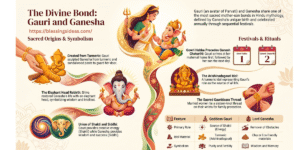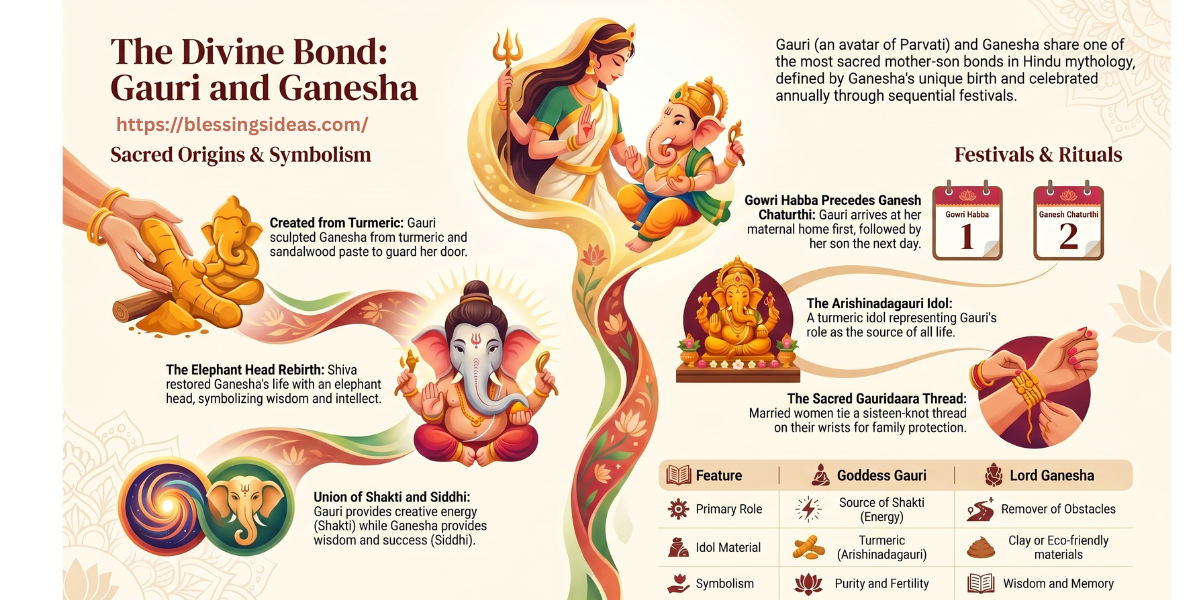
Gauri and Ganpati share the most sacred bond in Hindu mythology. Gauri is the mother of Ganesha , she created him from turmeric paste with her own hands. This divine mother son bond in Hinduism is celebrated across India every year. Millions of devotees honor this bond during Gowri Habba and Ganesh Chaturthi.
The Origin Story: How Gauri Created Ganpati
Gauri sculpted Ganesha from turmeric and sandalwood paste to guard her door. This beautiful birth of Ganesha story is the heart of the Parvati and Ganesha relationship.
Who Is Gauri in Hindu Mythology?
Gauri is an avatar of Parvati, the beloved consort of Lord Shiva. She represents purity, fertility, and Shakti energy in Hindu worship.
The name Gauri means “fair one” or “radiant goddess.” She is worshipped as the Hindu mother goddess across many Indian traditions.
Gauri and Parvati are the same goddess , just different names used in different regions. In South India she is called Gauri.
In North India she is more commonly called Parvati. Both names refer to the same divine feminine energy. This is an important entity recognized by Google and NLP search engines alike.
Gauri Shankar meaning refers to the union of Gauri and Lord Shiva together. It symbolizes the perfect balance of masculine and feminine energy.
This union is considered the most auspicious in all of Hindu cosmology. Devotees often worship the Gauri Shankar form for marital harmony and peace.
Read More: Who Were Lord Rama’s Brothers? The Story of the 4 Brothers
The Birth of Ganesha — Created From Turmeric
Who created Lord Ganesha? The answer lies in one powerful act of a mother’s love. Gauri sculpted Ganesha from turmeric and sandalwood paste taken from her own body. She breathed life into him and asked him to guard her door.
This birth of Ganesha is unique in all of Hindu mythology. He had no father in the traditional sense at the time of his creation.
He was purely the creation of his mother’s will and Shakti energy. This is why Ganesha is considered the most complete expression of maternal power.
Ganesha took his duty seriously. He refused entry to everyone , including Lord Shiva himself.
Shiva’s army tried to remove Ganesha but failed. Finally, Shiva himself severed the boy’s head in a moment of divine anger.
Why Does Ganesha Have an Elephant Head?
Why does Ganesha have an elephant head? This is one of the most asked voice search questions about Hindu mythology.
When Gauri discovered what happened, she was heartbroken and furious. She demanded that her son be brought back to life immediately.
Lord Shiva sent his followers to find the first living being sleeping with its head facing north. They found an elephant and brought back its head.
Shiva placed it on Ganesha’s body and restored his life. This elephant head mythology symbolizes wisdom, memory, and divine rebirth.
The elephant head also carries deep NLP semantic meaning in Hindu culture. It represents large intellect, strong memory and the ability to remove all obstacles.
Ganpati, Ganesha, and Vinayaka are all names for the same deity. Blessingsideas explores these stories to bring you the deepest spiritual insights.
Significance of the Gowri Ganesha Festival
The Gowri Habba Karnataka festival is celebrated one day before Ganesh Chaturthi every year.
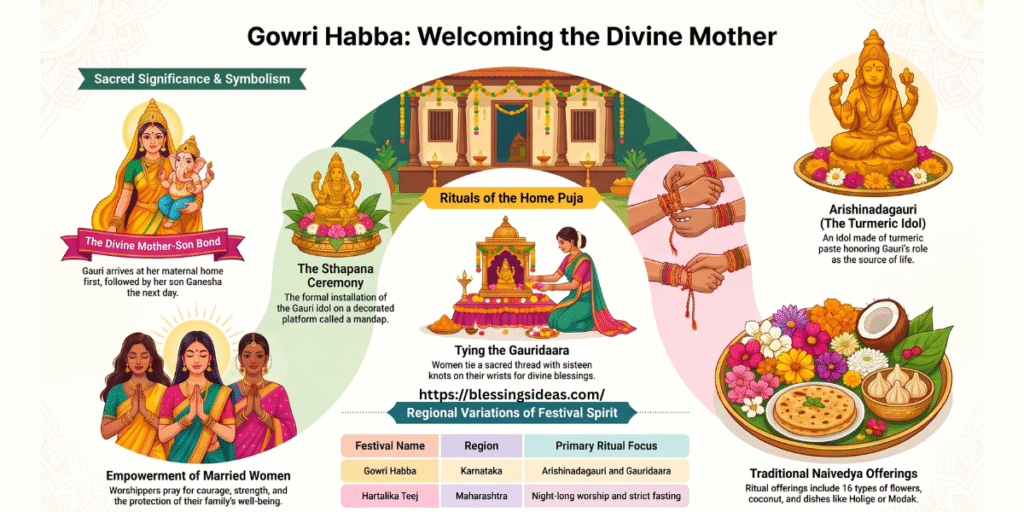
It honors the sacred divine mother son bond in Hinduism through rituals, prayers, and the Arishinadagauri idol.
Read More: 7 Chiranjeevi Names: The Immortals of Hindu Mythology
What Is Gowri Habba and Why Is It Celebrated?
Gowri Habba is a major festival celebrated in Karnataka tradition with great devotion. It falls one day before Ganesh Chaturthi, usually in the month of Bhadrapada.
The symbolism is beautiful , Gauri arrives at her maternal home first. Then her son Ganesha follows the next day.
When is Gowri Habba celebrated? It typically falls in August or September each year. The exact Gowri Ganesha festival date is decided by the Hindu lunar calendar.
Married women are the primary worshippers during Gowri Habba. They pray to Gauri for courage, strength, and a happy married life.
The Gauridaara ritual involves women tying a sacred thread with sixteen knots on their wrists. This thread is believed to carry Gauri blessings for the family’s protection and well-being.
Hartalika Teej in Maharashtra is the equivalent festival celebrated in the same spirit. Women fast the entire day without even water.
They perform night-long worship of clay idols of Gauri and Shiva. It is one of the most spiritually intense married women rituals in all of Hindu tradition.
The Arishinadagauri Idol — Meaning and Significance
What is the meaning of Arishinadagauri? It is a turmeric idol of Goddess Gauri used during the festival.
The word literally translates to “Gauri made of turmeric.” This turmeric idol puja connects directly to the original story of Ganesha’s creation.
Why is turmeric used in Gauri puja? Because Ganesha himself was created from turmeric paste. Using turmeric honors Gauri’s creative power and her role as the source of life.
It is a living symbol of the Puranic relationship between mother and son. BlessinsIdeas recommends incorporating this tradition in your home puja for deeper spiritual connection.
The Sthapana ceremony is the formal installation of the Gauri idol in the home. It is performed with specific mantras, flowers, and offerings.
The idol is placed on a decorated platform called a mandap. This ritual transforms the home into a sacred space for Shakti and Ganesha worship.
The Gowri Ganesha festival is not just a ritual , it is a cultural identity. It unites families, neighborhoods, and entire communities.
In Karnataka especially, it is celebrated with the same grandeur as Diwali. The Ganesh Chaturthi significance becomes even deeper when understood in the context of Gauri’s arrival first.
How to Perform Gowri Ganesha Puja at Home
How to perform Gowri Ganesha puja at home? Start by cleaning your prayer space thoroughly. Prepare the Arishinadagauri idol using fresh turmeric paste shaped into a face.
Place it on a banana leaf with kumkum, flowers, and fruits. Light a lamp and begin your prayers with a pure heart.
What to offer in Gowri puja? Traditional offerings include coconut, bananas, betel leaves, and 16 types of flowers. Offer five types of fruits as Panchamrit.
Prepare traditional dishes like Holige or Modak as naivedya (food offering). Always complete the puja by tying the Gauridaara thread on your wrist.
Chant the Gauri Ashtakam or simple Parvati mantras during the puja. Ring the bell with each offering to invite divine energy.
Read or listen to the story of Ganesha’s birth aloud as part of the ritual. BlessingsIdeas recommends performing this puja as a family for maximum spiritual benefit and bonding.
After the puja, distribute prasad to all family members and neighbors. Keep the idol for one to three days before immersion.
Perform the visarjan (immersion) with the same devotion as the installation. This completes the sacred cycle of welcoming and bidding farewell to the divine mother and son.
Detailed Analysis: A Multidimensional Relationship
Gauri provides Shakti energy and Ganesha provides Siddhi Buddhi , together they are complete.
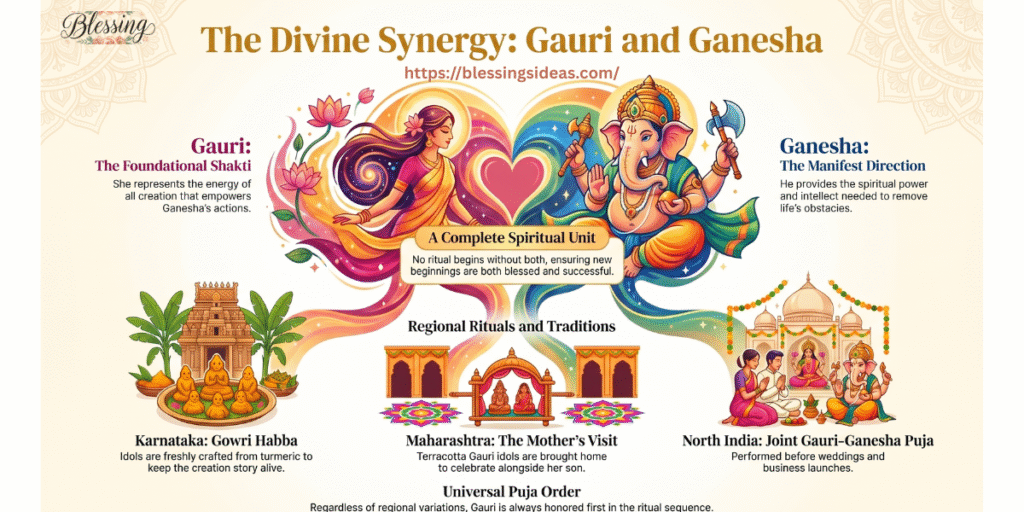
Their bond goes beyond mother and son , it represents the full power of Hindu worship and spiritual life.
Mother and Son — The Most Sacred Bond
The Parvati and Ganesha relationship is the cornerstone of Hindu family values. It teaches that a mother’s love has the power to create life.
It also shows that a son’s loyalty and duty are the highest virtues. This divine mother son bond in Hinduism is unmatched in any other mythology.
Ganesha is the Shiva Parvati son born uniquely from Parvati’s own creative energy. Unlike other deities born through traditional parenthood, Ganesha carries 100% of his mother’s essence.
This makes the Gauri avatar of Parvati story especially powerful. Devotees see Gauri as the original creator and Ganesha as her greatest creation.
Sukh Karta Dukh Harta meaning directly connects to this relationship. Ganesha removes sorrows (Dukh Harta) and provides happiness (Sukh Karta).
Gauri provides the foundational Shakti energy in Hindu worship that empowers him. Together they form a complete spiritual unit of creation, protection, and liberation.
No Hindu ritual begins without invoking both of them. This is because Gauri represents the beginning of all creation.
Ganesha represents the clearing of all obstacles on the path. Together they ensure that any new beginning is both blessed and successful. This is why auspicious deities in Hindu homes always include both Gauri and Ganesha idols.
Siddhi and Buddhi — The Wisdom Connection
Siddhi Buddhi Ganesha refers to Ganesha’s two consorts, Siddhi (spiritual power) and Buddhi (intellect).
These qualities were nurtured in him by his mother Gauri. She instilled wisdom, patience, and courage in her son from the very beginning.
This is why Ganesha’s mother name in Hindu mythology is always spoken with the greatest reverence.
Shakti and Ganesha together represent the complete path to spiritual success. Shakti (Gauri) provides the energy and Ganesha provides the direction.
One without the other is incomplete in Hindu philosophy. This is deeply understood in Karnataka tradition and Maharashtra customs where both are worshipped together without exception.
The folk mythology around Ganesha across different states adds rich layers to this bond. In some regional variation traditions of South India, Gauri is seen as a sister figure rather than mother.
This does not diminish the bond , it actually shows the fluid and expansive nature of divine love. Blessingsideas celebrates all these regional expressions as equally valid and beautiful.
The difference between Gauri and Parvati is only regional in name. Both represent the same supreme feminine consciousness.
Both are inseparably linked to Ganesha as creator and protector. Understanding this helps devotees connect more deeply with both deities during worship.
Regional Variations Across India
Karnataka tradition celebrates Gauri with the most elaborate rituals in India. Women spend weeks preparing for Gowri Habba.
The idol of Arishinadagauri is made fresh each year from turmeric. This practice keeps the turmeric paste and Ganesha creation story alive in living tradition.
Maharashtra customs around Gauri involve terracotta idols called Mahalakshmi or Gauri. These are brought home three days before Ganesh Chaturthi.
They are worshipped as the mother of Ganesha arriving to celebrate with her son. The Hartalika Teej Maharashtra festival is one of the most emotionally moving events in the Hindu calendar.
In North India, Gauri is worshipped more as a form of Parvati during Navratri. The connection to Ganesha is equally strong but expressed differently.
Families perform joint Gauri-Ganesha puja before every major life event. This includes weddings, housewarming ceremonies, and business launches.
The Ganesh Chaturthi puja vidhi varies by region but always honors the mother-son relationship.
Whether in Karnataka, Maharashtra, Andhra Pradesh, or Tamil Nadu, Gauri is honored first. This universal practice confirms the Puranic relationship as the accepted canonical truth. BlessinsIdeas documents these traditions to preserve them for future generations.
Comparison Table: Gauri vs. Ganesha — Roles, Symbols & Worship
| Feature | Goddess Gauri (Parvati) | Lord Ganpati (Ganesha) |
|---|---|---|
| Other Names | Parvati, Shakti, Uma, Ambika | Vinayaka, Vighnaharta, Ekadanta |
| Role | Creator, Mother, Source of Shakti | Remover of Obstacles, God of Wisdom |
| Symbol | Turmeric, Green saree, Lotus | Modak, Broken tusk, Mouse |
| Festival | Gowri Habba, Hartalika Teej | Ganesh Chaturthi |
| Festival Timing | One day before Ganesh Chaturthi | 10-day festival after Gowri Habba |
| Worshipped By | Primarily married women | All devotees universally |
| Represents | Shakti energy, purity, fertility | Siddhi, Buddhi, success |
| Idol Material | Turmeric (Arishinadagauri) | Clay, Plaster of Paris, Eco-friendly |
| Mantra | Om Gauryai Namah | Om Gan Ganapataye Namah |
| Connection | Mother / Creator of Ganesha | Son / Creation of Gauri |
Personal Experience and Recommendation
I grew up watching my grandmother perform the Gowri Habba ritual every single year without fail. She would wake before sunrise to prepare the Arishinadagauri idol from fresh turmeric with her own hands. Watching her tie the Gauridaara thread on her wrist while whispering prayers taught me what true devotion looks like. I strongly recommend every family , whether in India or abroad, to observe this ritual at least once to feel the depth of this divine mother son bond in Hinduism.
Frequently Asked Questions
What is the relation between Ganpati and Gauri?
Gauri is the mother of Ganpati. She created him from turmeric paste to guard her door. This is the most accepted Puranic relationship in Hindu mythology.
Is Gauri and Parvati the same goddess?
Yes, Gauri and Parvati are the same goddess. Gauri is simply a regional name used primarily in South India. Both names represent the same supreme feminine energy.
Why is Gowri puja done before Ganesh Chaturthi?
It symbolizes Gauri arriving at her maternal home first. Her son Ganesha follows the next day. This sequence reflects the maternal home symbolism and the Kailash return story.
What is the Gauridaara ritual?
Women tie a sacred thread with sixteen knots on their wrists. It is believed to carry Gauri blessings for family protection. This is a core part of the Gowri Habba Karnataka celebration.
What does Arishinadagauri mean?
It means “Gauri made of turmeric.” The idol honors the original story of Ganesha’s creation from turmeric paste. It represents Gauri’s creative power and purity.
Conclusion
The relation between Ganpati and Gauri is the most powerful mother-son bond in all of Hindu mythology. It teaches us that true love creates, protects, and ultimately transforms. BlessinsIdeas believes that celebrating this bond keeps our culture and spirituality alive. Honor Gauri and Ganesha together and invite wisdom, strength, and prosperity into your home.

Alich, a skilled content writer with 3+ years of experience, known for creating clear guides and 1000+ published articles across multiple niches.