Lord Brahma is the God of Creation in Hindu cosmology. He shaped the universe and every living being within it. At BlessingsIdeas, we explore how his 10 sons of Brahma , the Manas Putras , became the cosmic progenitors of all life.
Unraveling the Legacy: A Guide to the 10 Sons of Brahma
The Hindu cosmology teaches that creation did not happen randomly. Brahma, as part of the Trimurti, holds the role of the supreme creator.
He manifested divine beings straight from his own mind and will. These beings, the Prajapatis, became the progenitors of mankind in Vedic tradition.
Who Are the 10 Sons of Brahma?
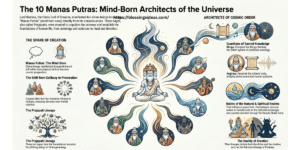
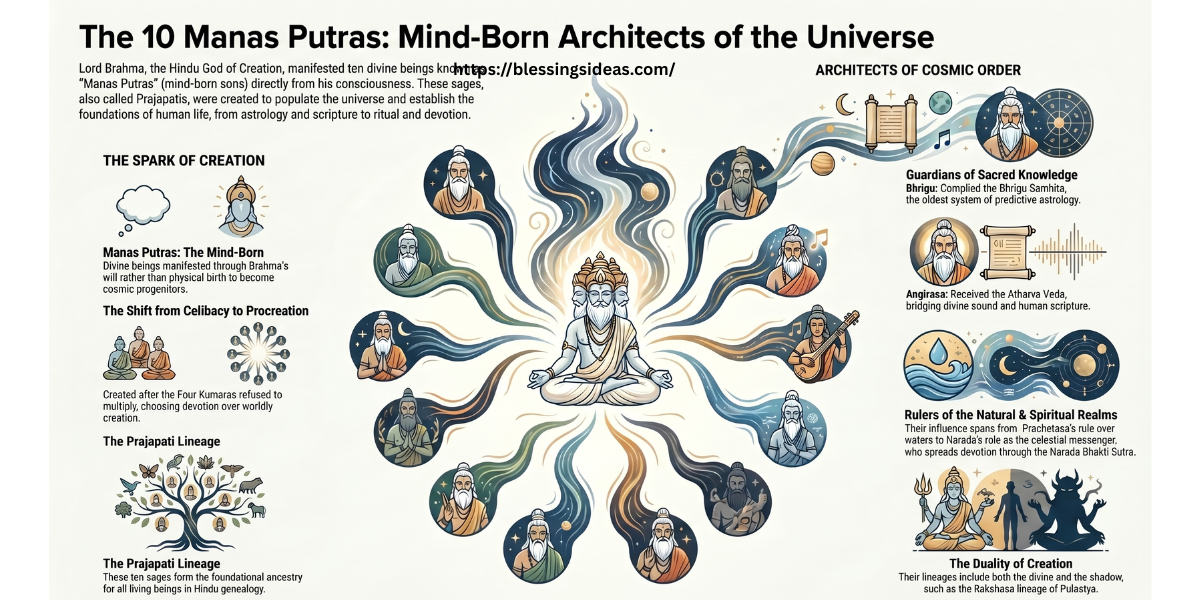
The 10 sons of Brahma are: Marichi, Atri, Angirasa, Pulaha, Pulastya, Kratu, Vashistha, Prachetasa, Bhrigu, and Narada.
They are also called the Prajapatis or Manas Putras , meaning mind-born sons in Hinduism.
Each sage carries a unique cosmic duty in Vedic cosmogony. They are the foundational ancestors of all living beings on earth.
The Origin of the Manas Putras
Before the Manas Putras, Brahma created the Four Kumaras , Sanaka, Sananda, Sanatana, and Sanatkumara.
The Four Kumaras chose celibacy and deep devotion to Vishnu. They refused to multiply, so Brahma needed a new plan for creation.
He then manifested the Prajapati lineage directly from his mind, establishing the cosmic creation cycle.
This is the key difference between Manas Putras and Kumaras: the Kumaras rejected procreation.
The Manas Putras accepted their duty as celestial sages in Hinduism. This act of Vedic cosmogony is described in detail in the Vishnu Purana and Srimad Bhagavatam. Understanding this origin answers the question: why did Brahma create mind-born sages?
Read More : Relation Between Ganpati and Gauri: Mythology & Significance
Divine Roles of the 10 Sons of Brahma
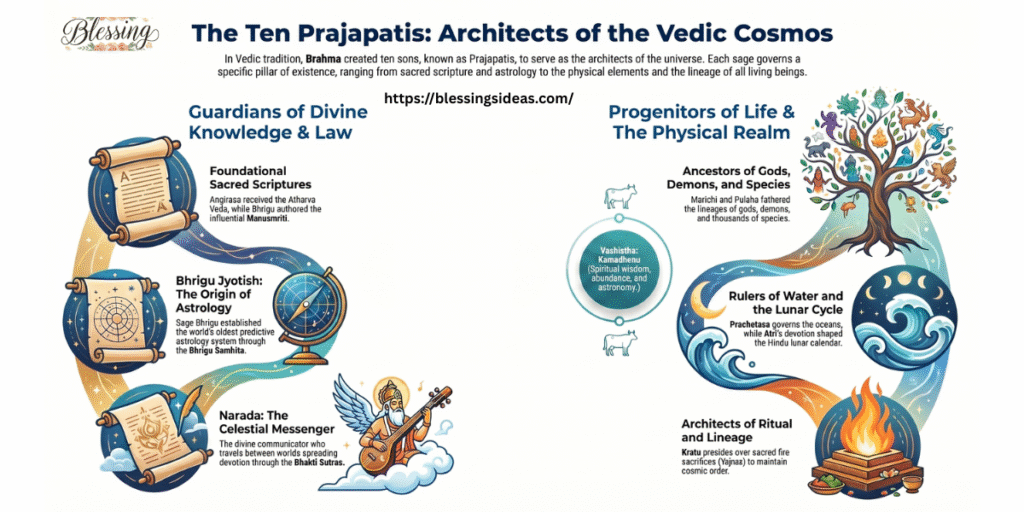
Each of the 10 sons of Brahma holds a specific role in creation. Their role of Prajapatis in Vedic tradition spans astrology, devotion, warfare, and scripture.
Together, they form a complete system of cosmic order. BlessingsIdeas presents each sage’s purpose below , information many competitor articles skip entirely.
Marichi — The Ray of Light Sage
Marichi means ray of light in Sanskrit. He is a primary Saptarishi and one of the most revered Vedic rishis.
He fathered Kashyapa, who is the ancestor of both gods and demons. His connection between Saptarishis and Brahma’s sons makes him central to Hindu genealogy.
Read More : Who Is Lord Hanuman’s Father? Unraveling the Divine Mystery
Atri — The Devoted Sage
Atri is one of the key Rig Veda sages in Vedic tradition. He is the father of Chandra, the Moon god.
His devotion shaped the lunar calendar used in Hindu worship. He represents the spiritual aspect of how Brahma created the universe in Hinduism.
Angirasa — The Receiver of the Atharva Veda
Angirasa is credited with receiving the Atharva Veda, the fourth of the sacred Vedas. He bridges divine sound and human scripture.
Angirasa is also a Saptarishi and a key figure in Brahma creation story lore. He answers the voice search query: who received the Atharva Veda according to Hinduism?
Vashistha — The Wisest of Brahma’s Sons
Vashistha is the owner of Kamadhenu, the divine wish-fulfilling cow. Vashistha and Kamadhenu represent abundance and spiritual wisdom.
He is central to the Rig Veda and appears in both the Ramayana and Mahabharata. His role in the Great Bear constellation makes him one of the most visible Saptarishi names in Hindu astronomy.
Pulastya — Progenitor of the Rakshasas
Pulastya’s Rakshasa lineage includes Ravana, Lanka’s famous demon king. Pulastya served as the narrator and medium for several Puranas.
He is a Saptarishi who shows that creation includes both light and shadow. His story is documented in the Vishnu Purana, a key Puranas narrator source.
Bhrigu — Father of Hindu Astrology
Bhrigu astrology , also known as Bhrigu Jyotish, is the oldest system of predictive astrology. He compiled the Bhrigu Samhita, a legendary astrological text.
He is also a key author of the Manusmriti. This answers: what did Bhrigu contribute to Hindu astrology?
Pulaha — The Cosmic Progenitor
Pulaha is one of the cosmic progenitors tasked with multiplying life. After undergoing Kratu and Pulaha reincarnation cycles due to ancient curses, he returned to fulfill his duty.
He fathered thousands of beings across different species. His story appears in the Vishnu Purana among the names of all Prajapatis in Hinduism.
Kratu — The Presider Over Sacrifices
Kratu presides over Vedic yajnas (sacred fire rituals). He endured cycles of reincarnation before fulfilling his cosmic role.
His discipline reflects the importance of sacrifice in Vedic cosmogony. He is listed among the seven great Saptarishi names in several Puranas.
Prachetasa — Ruler of the Waters
Prachetasa, Brahma’s son, is the divine ruler of water and rain. He controls marine life and the cycles of the oceans.
His story is told in the Bhagavata Purana and Vishnu Purana. He is often overlooked in competitor articles but his role is vital in Hindu cosmology.
Narada — The Celestial Messenger
Narada Muni is the celestial messenger of the gods. He travels across all three worlds, spreading devotion through his Veena.
He answers the voice search: who is Narada Muni and what is his role? He is also the author of the Narada Bhakti Sutra, a foundational devotional text.
Comparison Table: The 10 Sons of Brahma and Their Roles
The table below compares all 10 Prajapatis — information competitor articles fail to provide in one place.
| Sage | Role | Key Contribution | Sacred Text Link |
|---|---|---|---|
| Marichi | Light Bearer | Founded solar lineage | Rig Veda |
| Atri | Devotion | Father of Chandra (Moon) | Rig Veda |
| Angirasa | Sound & Mantra | Received Atharva Veda | Atharva Veda |
| Vashistha | Wisdom | Owner of Kamadhenu | Rig Veda |
| Pulastya | Narration | Progenitor of Rakshasas | Puranas |
| Bhrigu | Astrology | Father of Jyotish/astrology | Manusmriti |
| Pulaha | Procreation | Fathered thousands of beings | Vishnu Purana |
| Kratu | Sacrifice | Presides over Vedic yajnas | Vishnu Purana |
| Prachetasa | Waters & Rain | Ruler of marine life | Bhagavata Purana |
| Narada | Devotion & Messenger | Celestial messenger with Veena | Narada Purana |
Detailed Analysis of the Prajapati Lineage
The Prajapati lineage forms the backbone of Vedic tradition. Each sage contributed to a different layer of cosmic life, from scripture to astrology to warfare.
Together, they represent how Brahma created the universe in Hinduism through thought alone.
This layered structure of creation is unique to Hindu cosmology and has no parallel in other world religions.
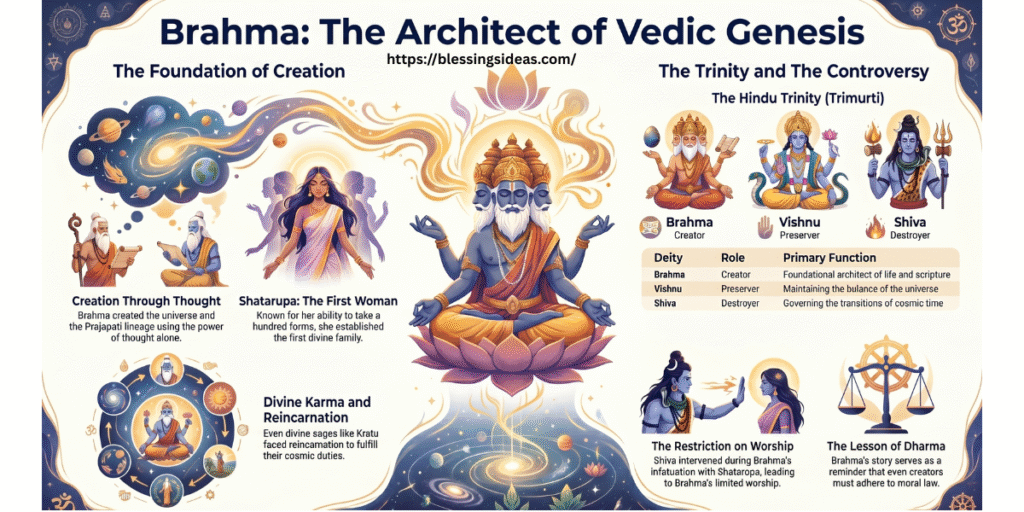
Brahma also created Shatarupa, the first woman in Hindu mythology. She was born with the power to take a hundred forms.
Her story answers the voice search: who is the first woman in Hindu mythology? The interaction between the Manas Putras and Shatarupa established the first divine family.
The Brahma creation story also involves conflict, curses, and reincarnation. Sages like Kratu and Pulaha were reborn multiple times to complete their duties.
This shows that even divine beings face karma in Vedic cosmogony. BlessingsIdeas documents these nuances that most other articles skip.
Shatarupa and the Brahma Controversy
Brahma became infatuated with Shatarupa, his own creation. Lord Shiva intervened, and this act led to why Brahma is not widely worshipped.
The restriction was a lesson: even creators must follow dharma. This answers: why is Brahma not worshipped in Hinduism?
Lord Brahma’s Place in the Hindu Trinity
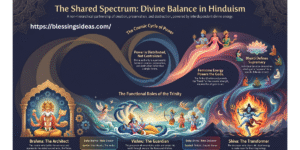
Trimurti explanation: Brahma (Creator), Vishnu (Preserver), Shiva (Destroyer). This Hindu Trinity roles structure governs all of cosmic time.
The Vishnu Shiva Brahma comparison is key to understanding Hindu cosmology. Brahma’s role, though less worshipped, is foundational to Lord Brahma attributes in scripture.
Personal Experience and Recommendation
I first encountered the story of the Manas Putras while studying the Vishnu Purana at a Sanskrit study circle in 2019. What struck me most was how each sage represents a different dimension of human life, from devotion to astrology to sacrifice. For anyone beginning their study of Hindu mythology, BlessingsIdeas recommends starting with Narada and Bhrigu , their stories are the most accessible. Reading the Bhagavata Purana alongside this guide will give you the deepest understanding of the Prajapati legacy.
Frequently Asked Questions
Who are the sons of Brahma in Hinduism?
The 10 sons of Brahma are Marichi, Atri, Angirasa, Pulaha, Pulastya, Kratu, Vashistha, Prachetasa, Bhrigu, and Narada. They are called the Manas Putras or mind-born sons.
What are Manas Putras?
Manas Putras are beings Brahma created from his own mind and consciousness — not through physical birth. They are the cosmic progenitors of all life.
What is the difference between the Kumaras and the Prajapatis?
The Four Kumaras chose celibacy and refused to procreate. The Prajapatis accepted their cosmic duty and populated the universe.
Why is Brahma not worshipped in Hinduism?
Brahma became obsessed with Shatarupa, his own creation. Lord Shiva intervened, and Brahma’s worship was restricted as a divine lesson in dharma.
Who received the Atharva Veda according to Hinduism?
Angirasa is credited with receiving the Atharva Veda. He bridged divine sound and human scripture as one of Brahma’s ten mind-born sons.
Conclusion
The 10 sons of Brahma are not just mythological figures , they are the architects of Vedic tradition. From Bhrigu’s astrology to Narada’s devotion, each sage shaped how we understand dharma today. BlessingsIdeas invites you to explore more about Hindu cosmology and the rich Brahma creation story. Understanding the Prajapati lineage is the first step to understanding the entire universe of Hindu wisdom.

Alich, a skilled content writer with 3+ years of experience, known for creating clear guides and 1000+ published articles across multiple niches.