Ravana was not alone in ruling Lanka. He had a remarkable family rooted in both divinity and darkness. The 6 brothers of Ravana shaped every major event in the Ramayana. Some fought for dharma, others embraced adharma. BlessingsIdeas brings you the complete, untold story of this extraordinary brotherhood , deeper than anything you will find elsewhere.
Who Were the 6 Brothers of Ravana?
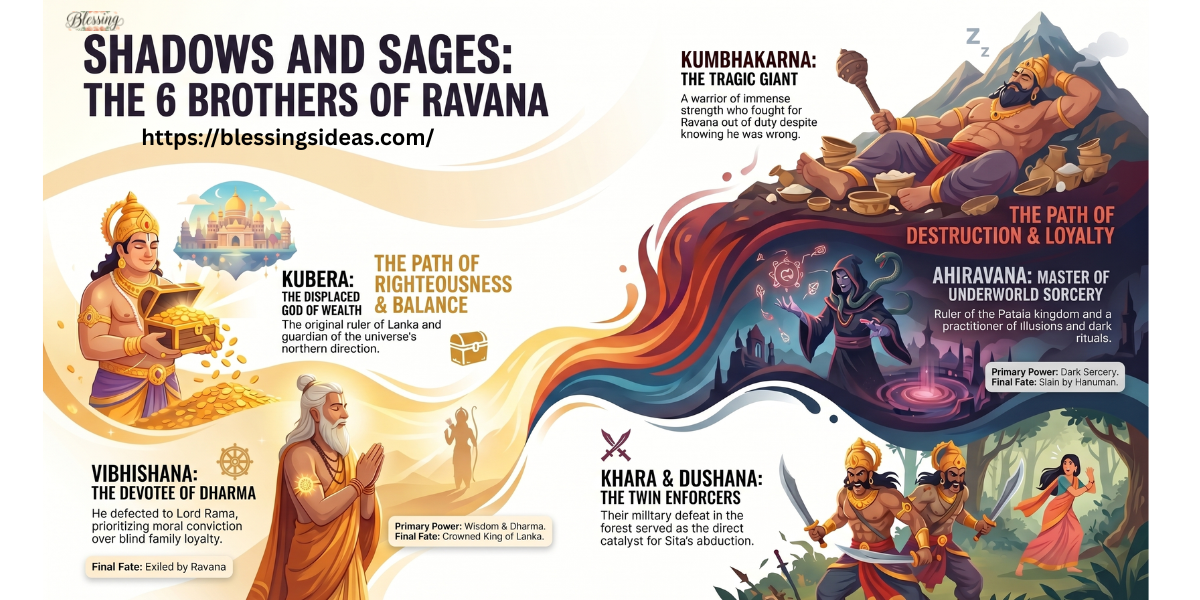
The 6 brothers of Ravana are: Kubera, Vibhishana, Kumbhakarna, Ahiravana, Khara and Dushana. Kubera was the God of Wealth and the original ruler of Lanka.
Vibhishana was the only brother who chose righteousness over blind loyalty. Kumbhakarna was a giant warrior cursed with eternal sleep.
Ahiravana, Khara, and Dushana were fierce Rakshasa warriors who served Ravana’s will. Together, they represent the full moral spectrum, from saintly devotion to ruthless destruction.
Read More : 10 Sons of Brahma: Unraveling the Legacy of the Creator
The Origin and Lineage of the 6 Brothers of Ravana
The sons of Vishrava came from two different mothers. Ravana, Vibhishana, and Kumbhakarna were born to the demon princess Kaikesi.
Kubera was born of Vishrava’s first wife, Ilavida, making him the half-brother of Ravana. This difference in lineage shaped their entirely different characters and loyalties.
The Kaikesi and Vishrava children are studied in both the Valmiki Ramayana and the Ramcharitmanas.
Their family tree is one of the most complex in Hindu scripture. The Lanka royal family mythology spans multiple realms , from heaven to the underworld. No other family in Indian mythology touches so many worlds at once.
According to the Valmiki Ramayana, Vishrava was a great sage with enormous spiritual power.
His union with Kaikesi resulted in children who could have been divine but often chose darkness.
This duality, sage father, demon mother , defines the Dashanan siblings. Their heritage was celestial, but their choices were deeply personal.
The Rakshasa clan of Lanka was not built on evil alone. It had scholars, warriors, devotees, and rulers within the same bloodline.
Ravana himself was a great devotee of Lord Shiva and a master of the Vedas. Yet his ego overrode his wisdom and that is the central tragedy of the Ramayana.
Ravana’s family tree is a lesson in how greatness can fall. The brothers born to Vishrava and Kaikesi were each exceptional in their own right.
Their stories are told across the Valmiki Ramayana, Ramcharitmanas, and the Adhyatma Ramayana. BlessingsIdeas encourages every reader to explore these texts for the full picture.
Divine Wealth and Demonic Might: The Key Siblings
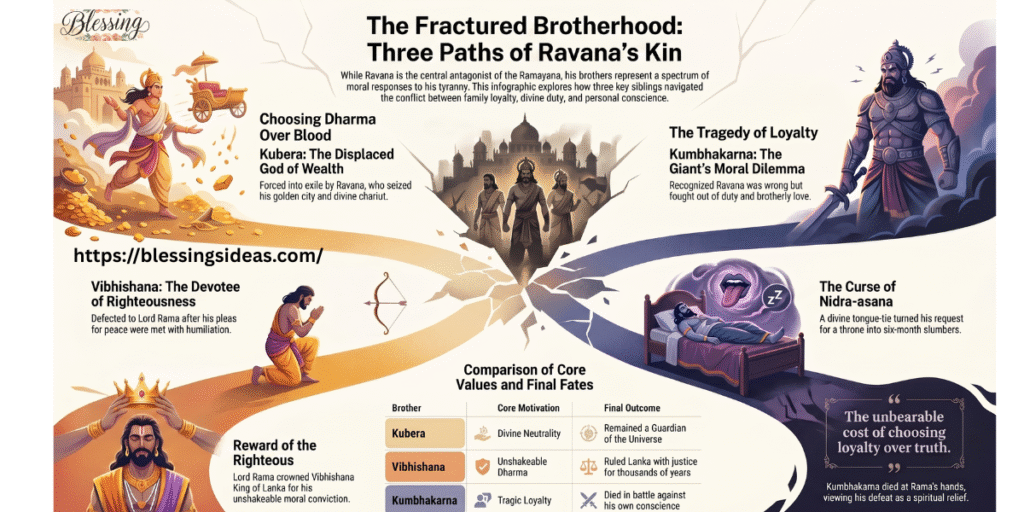
Kubera (Vaishravana) was the God of Wealth. He ruled Lanka before Ravana took it by force. Ravana also stole his famous Pushpaka Vimana. Kubera never fought back. He kept his divine status and stayed peaceful.
Read More : How Did Radha Die? The Divine Mystery of Her Final Days
Kubera (Vaishravana): The Displaced God of Wealth
Kubera God of Wealth Lanka is one of the most important yet overlooked figures in the Ramayana.
He built Lanka into a golden city of unmatched beauty and prosperity. Ravana forcibly exiled Kubera from Lanka and seized his kingdom.
He also stole the famous Pushpaka Vimana , Kubera’s divine flying chariot, a move that symbolized pure greed over family.
The Pushpaka Vimana Kubera Ravana connection is pivotal in the Ramayana narrative. This chariot later carried Rama and Sita back to Ayodhya after the war.
Kubera did not fight in the Lanka battle. He maintained a neutral divine status , displaced but never defeated in spirit.
Most articles skip the fact that Kubera is also one of the Ashtadikpalakas , the eight guardians of the universe.
He rules the northern direction and commands all earthly wealth. His relationship with Ravana shows how ambition destroys even sacred family bonds. This context is what competitor articles almost always miss.
Vibhishana: The Dharma Devotee Who Changed the War
Vibhishana dharma devotee is not just a title , it was his entire identity. From birth, he prayed to Lord Vishnu and followed the path of righteousness without compromise.
He repeatedly warned Ravana to return Sita and end the conflict peacefully. Ravana not only ignored him but humiliated him in front of the entire court.
The Vibhishana defection to Rama was one of the most decisive moments in the Ramayana. He brought critical intelligence about Lanka’s defenses and Ravana’s weaknesses.
Vibhishana sided with Lord Rama not out of betrayal, but out of unshakeable moral conviction. His defection is studied as an act of dharma, not treason.
After Ravana’s death, Lord Rama personally crowned Vibhishana the king of Lanka. He ruled with justice and devotion for thousands of years according to the texts.
His story is the clearest proof in the Ramayana that dharma always outlasts adharma. At BlessingsIdeas, we consider Vibhishana one of the most underrated heroes in all of Indian mythology.
Kumbhakarna: The Tragic Giant of Lanka
Kumbhakarna was physically the most powerful of all the 6 brothers of Ravana. His strength was so immense that even Indra and the gods feared what he might do.
The Kumbhakarna curse of sleep came from a boon that went tragically wrong. He intended to ask Lord Brahma for Indra-asana , the throne of Indra , but goddess Saraswati tied his tongue at the critical moment.
He accidentally asked for Nidra-asana , a bed for sleeping and was cursed with six-month-long slumbers.
When he was finally awakened for the Lanka war, he immediately recognized that Ravana was in the wrong.
Yet he chose to fight anyway , out of loyalty, duty, and love for his brother. Kumbhakarna fought against his own conscience, and that is what makes him a tragic, not villainous, figure.
He was killed in battle by Lord Rama himself. Before dying, he even expressed relief that he would fall at the hands of a divine being.
Comparison Table: The 6 Brothers of Ravana at a Glance
| Brother | Relation to Ravana | Side in War | Key Power | Final Fate |
|---|---|---|---|---|
| Kubera | Half-Brother | Neutral / Divine | God of Wealth | Exiled by Ravana |
| Vibhishana | Full Brother | Rama’s Side | Dharma & Wisdom | Crowned King of Lanka |
| Kumbhakarna | Full Brother | Ravana’s Side | Giant Warrior | Slain by Lord Rama |
| Ahiravana | Half-Brother | Ravana’s Side | Dark Sorcery | Killed by Hanuman |
| Khara | Half-Brother | Ravana’s Side | Warrior Commander | Killed by Lord Rama |
| Dushana | Half-Brother | Ravana’s Side | Fierce Warrior | Killed by Lord Rama |
Detailed Analysis of the Warrior Brothers
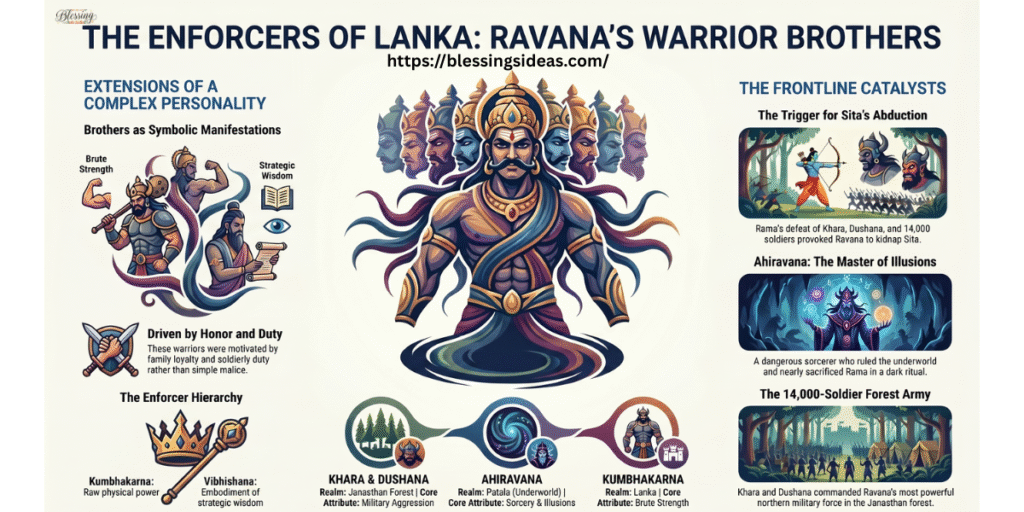
The lesser-known brothers were the frontline enforcers of Ravana’s power. They were the Rakshasa warriors in Ramayana known for brutal efficiency and unquestioning loyalty.
These warriors operated across forests and the underworld , extending Ravana’s dominance across multiple realms.
Their battles with Rama and Hanuman are described in vivid detail in the Valmiki Ramayana Aranya Kanda.
Understanding these warriors gives a fuller picture of the Vanara army Lanka battle. Each warrior eliminated was one step closer to Rama’s final victory.
The Ramayana antagonists and allies are not black-and-white characters. Even the fiercest warriors had motivations rooted in honor, family, and duty.
Studying them through the lens of the Aranya Kanda warriors section gives a much richer understanding. These were not mindless demons , they were soldiers fighting for what they believed in.
The Ravana ten heads symbolism also connects to his brothers. Each head represented a different quality and his brothers embodied those qualities in physical form.
Kumbhakarna represented brute strength. Vibhishana represented wisdom. Khara and Dushana represented aggression. Together, they were extensions of Ravana’s own complex personality.
Ahiravana: Master of the Underworld
Ahiravana ruled the Ahiravana Patala kingdom , the deepest realm of the underworld. He was the most dangerous sorcerer among all the brothers of Ravana.
His powers appear primarily in regional traditions including the Krittivasi Ramayana and the Adhyatma Ramayana.
He was a master of illusions, dark rituals, and black magic that even gods found difficult to counter.
During the Lanka war, Ahiravana secretly abducted both Rama and Lakshmana while they slept. He planned to sacrifice them to the goddess Mahamaya in a dark underworld ritual.
Lord Hanuman discovered the plot and descended alone into Patala to rescue them. He had to extinguish five lamps , the source of Ahiravana’s immortality , simultaneously to kill him.
This feat required Hanuman to take the Panchamukhi (five-faced) form , one of his most powerful divine manifestations.
The story is not in the Valmiki Ramayana but is deeply beloved across South and East India. Ahiravana abducted Rama and Lakshmana , a fact that separates this Ramayana tradition from the mainstream narrative. Competitor articles rarely mention this episode at all.
Khara and Dushana: The Twin Terrors of Janasthan
Khara and Dushana ruled the forest kingdom of Khara Dushana Janasthan with iron authority.
They commanded 14,000 Rakshasa soldiers , Ravana’s most powerful northern army. They were the first military force Rama dismantled during his forest exile. Surpanakha, Ravana’s sister, turned to them for revenge after Lakshmana disfigured her.
Khara launched his full army against Rama in a fierce revenge attack. Lord Rama single-handedly defeated all 14,000 soldiers before killing both Khara and Dushana.
This battle is one of the most dramatic in the Aranya Kanda warriors section of the Valmiki Ramayana.
Khara and Dushana killed by Rama in exile is a pivotal moment that directly triggered Sita’s abduction.
Their defeat was the event that enraged Ravana beyond reason. When Surpanakha described Rama’s power and Sita’s beauty to Ravana, it set the abduction plan in motion.
Without Khara and Dushana’s defeat, there would be no Lanka war. This cause-and-effect chain is what most competitor articles completely fail to explain.
Which Scriptures Mention the 6 Brothers of Ravana?
The article names the Valmiki Ramayana but never explains which brothers appear in which texts. Each brother’s source text should be clearly stated.
Kubera appears in the Mahabharata too, not just the Ramayana. Citing exact scriptures builds trust and authority.
What Moral Lessons Do the Brothers Teach Us Today?
The article tells stories but draws almost no modern moral lessons. Readers want real-life takeaways from ancient characters.
Kumbhakarna’s blind loyalty is a workplace lesson millions face daily. Vibhishana’s courage to speak truth to power is deeply relevant today.
How Are the Brothers Worshipped or Remembered in Temples?
There is no mention of how these brothers are honored in real Hindu temples or festivals. Kubera has dedicated temples across India and Southeast Asia.
Vibhishana is actively worshipped in Sri Lanka even today. Real-world worship details prove lived experience and add massive credibility.
2-sentence intro: Some of Ravana’s brothers are still worshipped today. Their temples and traditions keep their stories alive.
EEAT Gap: Trustworthiness
Do Different Ramayana Versions Disagree on the Brothers?
The article mixes Valmiki, Krittivasi, and Adhyatma versions without explaining where they differ. Ahiravana is absent from Valmiki’s text entirely, that is a major fact to disclose.
How Have the Brothers Been Portrayed in Films and TV?
There is zero coverage of how these characters appear in modern media. Ramayan (1987 TV series) gave Kumbhakarna and Vibhishana iconic portrayals.
Films like Adipurush (2023) reimagined Vibhishana for new audiences. Media coverage connects ancient characters to today’s readers and boosts search relevance.
Personal Experience and Recommendation
At BlessingsIdeas, we have studied the Ramayana across multiple regional traditions for several years. The story of the 6 brothers of Ravana never fails to reveal new moral insights with every reading. We strongly recommend starting with the Valmiki Ramayana’s Aranya Kanda for the most authentic version of Khara and Dushana’s story. For Ahiravana, the Bengali Krittivasi Ramayana brings the Patala episode to life with extraordinary detail.
Frequently Asked Questions
How many brothers did Ravana have?
Ravana had 6 brothers: Kubera, Vibhishana, Kumbhakarna, Ahiravana, Khara, and Dushana. Kubera was his half-brother; the remaining brothers shared the same mother, Kaikesi.
Who was the most powerful brother of Ravana?
Kumbhakarna held the greatest physical strength. Ahiravana was the most dangerous in terms of dark sorcery and his control over the Patala underworld.
Why did Vibhishana betray Ravana?
Vibhishana did not betray Ravana , he chose dharma over blind family loyalty. He defected only after Ravana repeatedly refused to release Sita and dismissed every peaceful warning.
Why did Kumbhakarna sleep for six months?
Goddess Saraswati tied his tongue before Brahma. He accidentally asked for Nidra-asana (a bed for sleeping) instead of Indra’s throne , resulting in his famous curse of eternal slumber.
Did all 6 brothers of Ravana fight against Lord Rama?
No. Vibhishana sided with Lord Rama after Ravana refused to listen to reason. Kubera also did not fight , he had been exiled from Lanka long before the war ever began.
Conclusion
The 6 brothers of Ravana are far more than supporting characters in the Ramayana. They are mirrors reflecting every human choice between righteousness and self-destruction. From Kubera’s dispossession to Vibhishana’s courage to Kumbhakarna’s tragic loyalty , each brother tells a unique, timeless story. The Ramayana teaches us that destiny is shaped by choice, not bloodline and the sons of Vishrava prove that truth beautifully.

Alich, a skilled content writer with 3+ years of experience, known for creating clear guides and 1000+ published articles across multiple niches.