Hinduism has seven immortal beings called Sapta Chiranjeevi. These Kali Yuga survivors have lived for thousands of years with a divine purpose. At BlessingsIdeas, we reveal every name, story, and secret behind the 7 Chiranjeevi names.
The Concept of the 7 Chiranjeevi Names in Sanatan Dharma
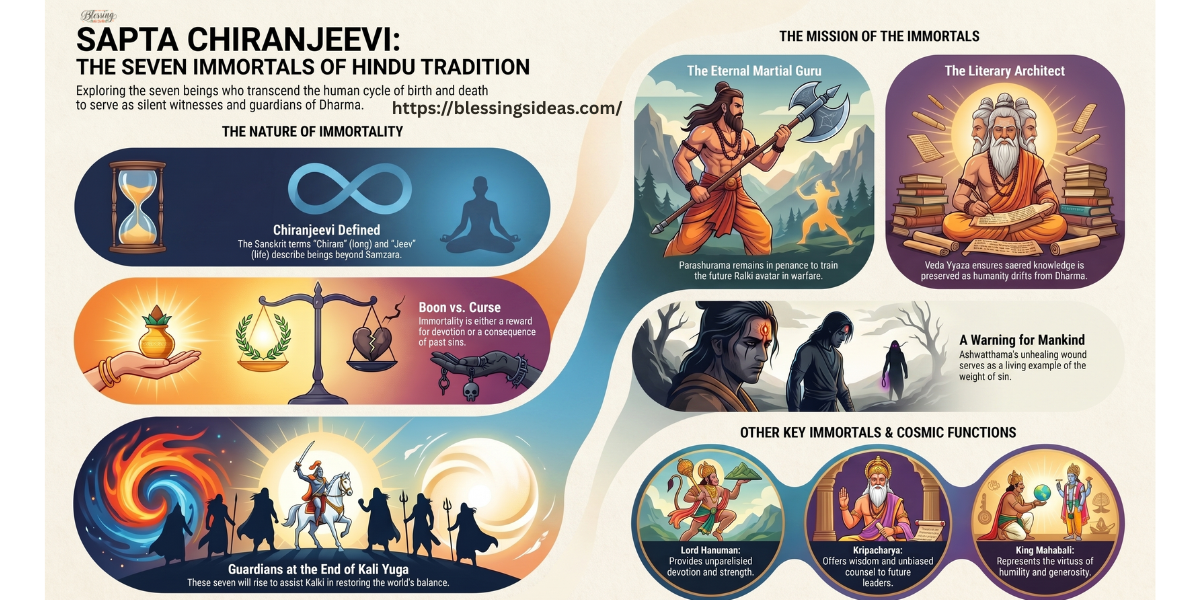
Sanatan Dharma immortals have fascinated scholars and devotees for centuries. The word Chiranjeevi comes from two Sanskrit words , Chiram meaning “long” and Jeev meaning “life.”
Together, they describe beings who live beyond the normal Samsara cycle of birth and death. Most souls reincarnate again and again. But these seven are exempt from that cycle entirely.
The Chiranjeevi shloka meaning goes deep into cosmic purpose. Each of the seven was either blessed or cursed to remain on Earth. Some carry boons of devotion.
Others carry the weight of past sins. The number 7 holds great significance in Hindu tradition , just like the Saptarishi (seven sages), these seven immortals represent the full spectrum of human virtue and consequence.
They come from different Yugas. Yet all of them exist in our current age. They are silent witnesses to the rise and fall of civilizations. On BlessingsIdeas, we believe understanding them helps us live with more purpose.
Personal Experience and Recommendation: I first came across the Sapta Chiranjeevi mantra chanting benefits during a temple visit in Varanasi.
Chanting the shloka daily brought me a deep sense of calm and clarity. I recommend reading about each immortal individually , their stories carry real life lessons. At BlessingsIdeas, we encourage you to go beyond the names and explore their meaning.
The Divine Mission and Benefits of the Immortals
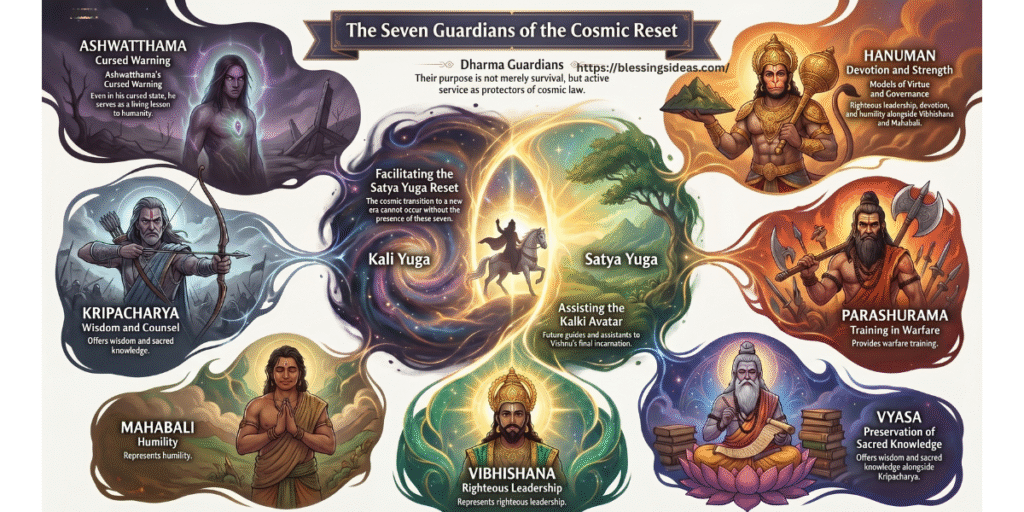
The purpose of the 7 immortals is not just survival , it is service. They are the Dharma guardians at the end of Kali Yuga.
Their mission is directly tied to the coming of Kalki, the 10th avatar of Vishnu. When the world reaches its darkest point, these seven will rise again to assist Kalki in restoring balance.
Each immortal plays a unique role in this cosmic plan. Hanuman will provide devotion and strength.
Parashurama will train Kalki in warfare. Kripacharya will offer wisdom and counsel. Vyasa will preserve sacred knowledge.
Vibhishana will model righteous governance. Mahabali will represent humility and generosity. And Ashwatthama, even in his cursed state , serves as a warning to all.
The role of Chiranjeevi in the Kalki avatar is recognized across the Puranas. The Kalki Purana specifically names several of them as future guides.
This is not myth for the sake of story. It is a cosmic arrangement. The Satya Yuga cosmic reset cannot happen without their presence.
Understanding these seven helps us align with Dharma in our own lives. Each one teaches something timeless. Their stories are not just ancient , they are alive and relevant at BlessingsIdeas.
Detailed Analysis: Exploring the 7 Chiranjeevi Names
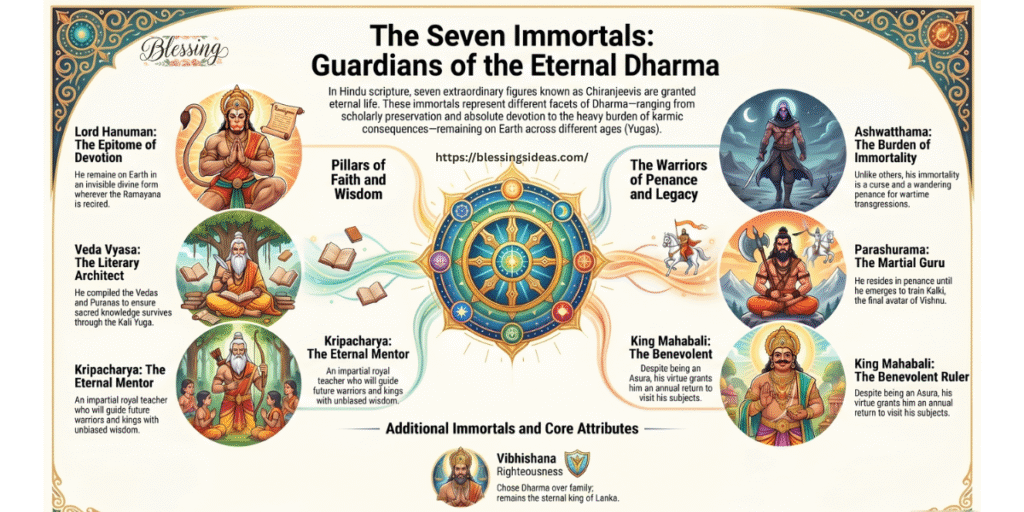
The 7 Chiranjeevi names carry centuries of wisdom, devotion, and divine purpose. Each immortal has a unique story that still shapes Sanatan Dharma today.
1. Lord Hanuman: The Epitome of Devotion
Hanuman’s immortality boon is one of the most beloved stories in all of Hindu scripture. He was blessed by Lord Indra with invincibility and by Lord Rama himself with eternal life.
He chose to remain on Earth as long as the name of Rama is chanted anywhere. He is the Chiranjeevi known for devotion to Ram above all others.
Wherever the Ramayana is recited, Hanuman is believed to be present in his Sukshma Roopa , invisible divine form.
2. Ashwatthama: The Burden of Immortality
Ashwatthama’s curse in the Mahabharata is the darkest story among the seven. After committing heinous acts during the war , including killing sleeping warriors and using the Brahmastra against an unborn child .
Lord Krishna cursed Ashwatthama to wander the Earth for 3,000 years with an unhealing wound on his forehead.
Why is Ashwatthama still alive? Because his curse has not yet ended. His story is the clearest example of how divine boon and curse in Hindu scripture are two sides of the same coin.
3. Parashurama: The Warrior Sage
Parashurama, the sixth avatar of Vishnu, is the bridge between two ages. He lived during the Treta and Dvapara Yuga and continues into our Kali Yuga.
He currently resides in deep penance on Mahendra Parvat. Which avatar will Parashurama train? According to the Kalki Purana, he will emerge as the martial guru of Kalki and train him in the art of divine warfare. He is proof that a warrior can also be a sage.
4. King Mahabali: The Benevolent Ruler
How did Mahabali become immortal? His virtue was so extraordinary that even Lord Vishnu could not deny him.
Despite being an Asura king, Mahabali ruled with complete justice and generosity. Vishnu came to him as Vamana , the dwarf avatar and pushed him into the underworld.
But even then, Vishnu granted him the boon to visit his people once a year. The King Mahabali Onam story is celebrated every year in Kerala as the festival of Onam , a joyful reunion between a king and his subjects.
Read More : Sri Ganesh Temple Secunderabad – Timings, History, Architecture, Festivals, Pooja Details
5. Veda Vyasa: The Literary Architect
Veda Vyasa, the compiler of the Vedas, is the most intellectually significant of the seven immortals.
He authored the Mahabharata, compiled the four Vedas, and wrote the 18 Puranas. Veda Vyasa’s role in Kali Yuga is to ensure that sacred knowledge is never lost, even as humanity drifts away from Dharma.
He was born of sage Parashara and a fisherwoman named Satyavati , a reminder that wisdom has no caste. His immortality is not a reward or a punishment. It is a necessity.
6. Vibhishana: The Guardian of Dharma
Is Vibhishana still king of Lanka? According to Hindu tradition, yes. Lord Rama appointed him as the eternal king of Lanka after the defeat of Ravana.
Vibhishana chose Lanka and Dharma over family loyalty , a decision that cost him everything personally but earned him immortality.
He is a model of righteous governance. His story shows that Dharma is more important than blood ties.
7. Kripacharya: The Eternal Mentor
Is Kripacharya one of the seven immortals in the Mahabharata? Absolutely yes. Kripacharya was the royal teacher of the Kauravas and the Pandavas alike.
He was known for perfect impartiality , he taught both sides with equal dedication. He survived the Kurukshetra war and was granted eternal life to serve as a teacher for future generations. In the age of Kalki, he will once again guide warriors and kings with unbiased wisdom.
Comparison Table: The 7 Chiranjeevis at a Glance
| Chiranjeevi | Origin | Reason for Immortality | Role in Kali Yuga |
|---|---|---|---|
| Lord Hanuman | Treta Yuga | Boon — devotion to Rama | Present wherever Rama’s name is chanted |
| Ashwatthama | Dvapara Yuga | Curse — crimes in Mahabharata war | Wanders Earth with unhealing wound |
| Parashurama | Treta Yuga | Boon — avatar of Vishnu | Penance on Mahendra Parvat; will train Kalki |
| King Mahabali | Satya Yuga | Boon — supreme virtue | Visits Earth annually (Onam) |
| Veda Vyasa | Dvapara Yuga | Boon — preserver of knowledge | Guards sacred scriptures for mankind |
| Vibhishana | Treta Yuga | Boon — righteousness over loyalty | Eternal king of Lanka |
| Kripacharya | Dvapara Yuga | Boon — impartial teacher | Will guide warriors in age of Kalki |
Is There an 8th Chiranjeevi?
This is one of the most searched questions , 8 Chiranjeevis vs 7: who is correct? The traditional count is seven.
But many Puranic traditions include Sage Markandeya as the eighth. Markandeya’s eternal youth was granted by Lord Shiva after the young sage fiercely refused to accept death.
When Yama, the God of Death, came for him, Markandeya clung to a Shiva Lingam. Lord Shiva appeared and defeated Yama himself.
Markandeya was blessed to remain forever sixteen years old. His inclusion depends on the regional or sectarian tradition you follow. At BlessingsIdeas, we present both views so you can decide for yourself.
Read More : Guruvayur Temple: Complete Guide to Kerala’s Holiest Krishna Shrine
Personal Experience & Recommendation
I discovered the Sapta Chiranjeevi shloka during my first visit to Varanasi. Chanting it daily brought me real peace and spiritual clarity. I recommend every seeker on BlessingsIdeas to study each immortal separately. Their stories will change how you see life, devotion, and Dharma.
Frequently Asked Questions
What does Chiranjeevi mean in Sanskrit?
Chiranjeevi means “one who lives long.” Chiram = long, Jeev = life. It refers to beings who transcend the normal cycle of birth and death.
What is the Chiranjeevi shloka and what does it mean?
The Chiranjeevi shloka lists all seven immortals by name. Reciting it daily is believed to bless the devotee with long life, good health, and protection from evil.
Where does Parashurama live right now according to Hindu scriptures?
Parashurama resides in deep penance on Mahendra Parvat (Mahendra Mountain). He waits there until the arrival of Kalki avatar to begin his role as martial guru.
Why does Onam celebrate King Mahabali’s return?
Onam marks the annual visit of King Mahabali to his former kingdom in Kerala. Lord Vishnu granted him this boon because of his extraordinary virtue and love for his people.
What is the difference between Chiranjeevi and Amara in Sanskrit?
Chiranjeevi means “long-lived”, they can eventually conclude their earthly role. Amara means “truly immortal” , beyond any end. The seven Chiranjeevis are long-lived, not permanently undying.
Conclusion
The names and stories of immortals in Hinduism are more than mythology. They are mirrors of the human experience , showing us devotion, consequence, wisdom, and resilience. Each of the Kali Yuga survivors carries a lesson we can apply right now in our own lives. At BlessingsIdeas, we believe these seven souls are still watching , guiding, warning, and inspiring. Their stories do not end. And neither does their relevance.

Alich, a skilled content writer with 3+ years of experience, known for creating clear guides and 1000+ published articles across multiple niches.