Lord Hanuman is one of the most powerful gods in Hindu dharma. Millions of devotees worship him daily across the world. But many people ask , who is Lord Hanuman’s father? The answer involves King Kesari, Vayu Dev, and Lord Shiva. In this article, Blessinsideas reveals the complete truth behind Hanuman’s divine parentage.
Who Is Lord Hanuman’s Father? Quick Overview
Most people know Hanuman as the devoted servant of Lord Rama. But his birth story is deeply layered. He has not one, but three father figures in Hindu tradition.
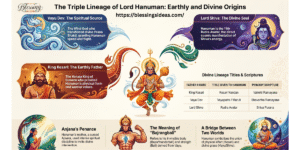
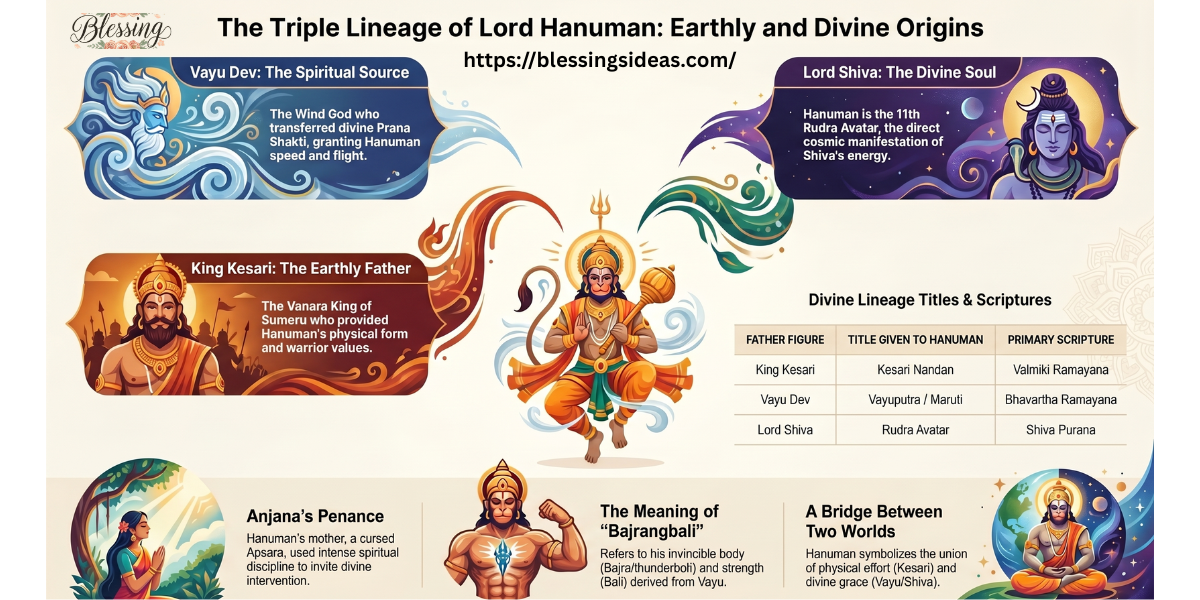
His biological father is King Kesari. His spiritual father is Vayu Dev, the Wind God. And his divine origin traces back to Lord Shiva / Rudra himself.
Understanding Hanuman’s divine parentage helps us understand his superhuman strength. It also explains why he carries so many powerful titles and names. Each name reflects a different part of his celestial birth.
The Earthly Lineage — King Kesari and Anjana
King Kesari was a mighty Vanara king of Sumeru kingdom. He and his wife Anjana performed deep penance to receive a divine child.
Who Is King Kesari in Ramayana?
King Kesari was a mighty Vanara chief warrior who ruled the Sumeru kingdom. He was brave, righteous, and deeply devoted to the gods.
The Kishkindha Kanda birth account in the Valmiki Ramayana confirms his role as Hanuman’s earthly father.
Kesari was not an ordinary Vanara king. He was powerful enough to defeat mighty demons. He lived a life of devotion and penance alongside his wife Anjana. Together, they longed for a divine child.
Because of Kesari’s role, Hanuman proudly carries the title Kesari Nandan, meaning “Son of Kesari.” This title represents earthly valor and warrior spirit.
It connects Hanuman to the physical world of courage and discipline. The Vanara tribe origin and royal lineage gave Hanuman his physical form and strength.
Kesari raised Hanuman with love and wisdom. He taught him the values of duty, bravery, and loyalty.
This earthly foundation shaped Hanuman into the greatest devotee and warrior. Without Kesari, Hanuman’s physical existence would not have been possible.
Read More : Who is the Most Powerful God in Hinduism?
The Story of Anjana Mata — A Celestial Nymph on Earth
Anjana, the mother of Hanuman, was originally an Apsara in the heavenly realm. Due to a curse, she was born on Earth as a Vanara woman. This is the famous Anjana mata curse story that most articles completely ignore.
Anjana was beautiful, wise, and spiritually powerful. She married King Kesari and lived in the Sumeru kingdom.
But her heart ached for a child who could carry divine power. She began intense penance for a child directed toward Lord Shiva.
Her devotion was unshakeable. She prayed for years without rest. Shiva’s blessing on Anjana finally answered her prayers. That blessing set in motion the most extraordinary birth in Hindu mythology.
Anjana’s story teaches us that devotion and penance can move even the heavens. She is celebrated as Anjaneya’s mother and Hanuman proudly carries her name.
The titles Anjaneya and Anjaniputra both mean “Son of Anjana.” Her sacrifice and love are inseparable from Hanuman’s identity.
The Divine Connection — Vayu Dev and the Wind God’s Role

Vayu Dev carried sacred payasam to Anjana during her prayers. This divine act made Hanuman the powerful Vayuputra , Son of the Wind.
Why Is Hanuman Called Vayuputra?
Vayuputra means “Son of Vayu.” Vayu Dev is the Wind God in Hindu mythology , one of the most powerful Vedic deities. But how did Vayu become Hanuman’s father?
According to the Bhavartha Ramayana, King Dasharatha performed the Putrakameshti yajna , a sacred ritual for sons.
The ritual produced divine payasam , a sacred pudding filled with Prana Shakti. Vayu carried a portion of this sacred payasam through the wind to Anjana as she prayed.
The divine payasam from Dasharatha’s yagna entered Anjana’s hands. She consumed it with complete faith.
This act transferred the wind god’s powers into her unborn child. That child was Lord Hanuman.
This is why Hanuman can fly at immense speeds. This is why he has limitless vitality and superhuman strength.
The Pavanputra significance lies in this direct transfer of divine energy. Vayu Dev did not raise Hanuman but he gave him the breath of life and supernatural power.
Read More : Is Lord Hanuman Still Alive? Proof & Where He Is Now
What Does Pavanputra Mean?
Pavanputra is another title for Hanuman. Pavana is another name for the Wind God — Maruta. So Maruti name meaning literally translates to “Son of Maruta” or Son of the Wind.
This name is especially popular in Maharashtra and South India. Devotees call Hanuman Maruti with deep affection. The Anjaneya name origin in South Indian tradition comes from the same divine story.
Bajrangbali origin also connects to his divine body , Bajra means thunderbolt-hard, and Bali means strength.
His body was made invincible by Vayu’s energy. Every name Hanuman carries is rooted in this miraculous celestial birth Hindu tradition.
Lord Shiva’s Role — The Rudra Avatar Mystery
Lord Shiva blessed Anjana and incarnated through her womb. Hanuman is confirmed as the Rudra Avatar — the 11th form of Shiva.
Is Hanuman a Son of Shiva or Vayu?
This is one of the most searched clarification queries among devotees. The answer is — both are true, but in different ways.
The Shiva Purana describes Hanuman as the Rudra Avatar of Shiva — specifically the 11th manifestation of Lord Shiva.
Lord Shiva responded to Anjana’s prayers personally. He chose to incarnate in her womb through the medium of Vayu Dev.
So Vayu was the channel. Shiva was the divine soul. And Anjana was the blessed mother. This is the true meaning of Ansh Avatar , a partial divine incarnation through human form.
The Hanuman Chalisa father reference points to this connection too. The Chalisa was written by Tulsidas and emphasizes Hanuman’s divine nature rooted in Shiva’s energy.
Many American Hindu scholars today recognize Hanuman as the perfect bridge between Shaivism and Vaishnavism. He is the devotee of Rama , yet the incarnation of Shiva.
Comparison Table — Hanuman’s Three Father Figures
| Father Figure | Type | Role | Title Given to Hanuman | Scripture Reference |
|---|---|---|---|---|
| King Kesari | Biological / Earthly | Raised Hanuman, gave physical form | Kesari Nandan | Valmiki Ramayana, Kishkindha Kanda |
| Vayu Dev | Spiritual / Divine | Transferred wind powers via payasam | Vayuputra / Pavanputra / Maruti | Bhavartha Ramayana |
| Lord Shiva / Rudra | Cosmic / Soul | Incarnated as Ansh Avatar in Anjana’s womb | Rudra Avatar / Shankar Suve | Shiva Purana |
This table clearly shows the dual parentage in Hindu mythology — and even triple parentage in Hanuman’s unique case. No other deity in Hindu tradition carries this level of layered divine origin.
The Symbolism of Dual Parentage — Earth Meets Heaven
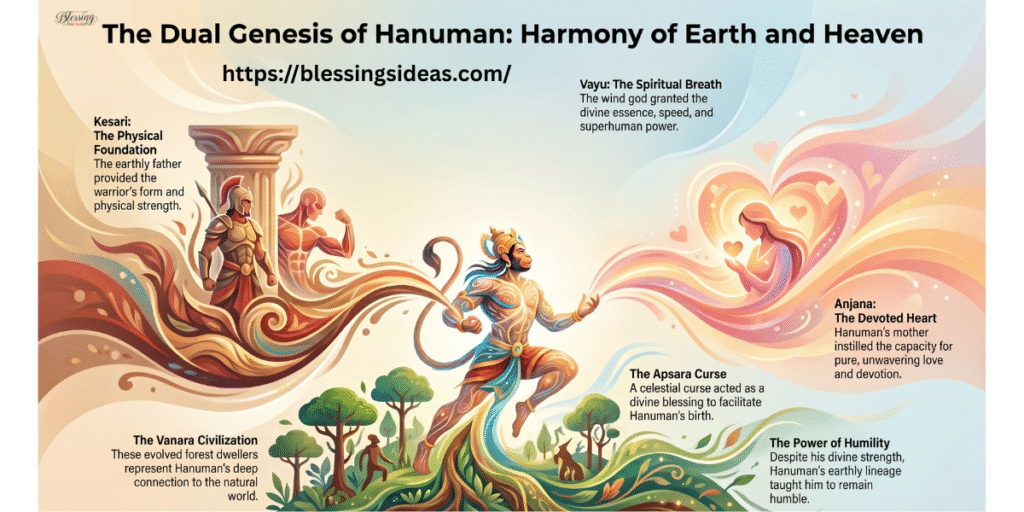
Kesari gave Hanuman his physical strength and warrior spirit. Vayu and Shiva gave him divine power and limitless energy.
What Does Hanuman’s Dual Parentage Symbolize?
Hanuman’s divine parentage is not just mythology. It carries deep philosophical meaning for every devotee. It shows that human effort and divine grace must work together.
Kesari gave the body, the warrior’s form. Vayu gave the spirit , the breath and speed. Anjana gave the heart , pure devotion and love. Together, these three made Hanuman the greatest being in the Ramayana.
The Sundara Kanda of the Valmiki Ramayana shows Hanuman in his full glory. He crosses the ocean. He finds Sita. He burns Lanka.
All of this was possible because of his superhuman strength origin rooted in both earthly and divine lineage.
This symbolism is deeply relevant even today. It reminds us that our physical efforts (Kesari) combined with divine blessings (Vayu/Shiva) can achieve the impossible. Hanuman is not just a mythological hero , he is a living principle of spiritual empowerment.
How the Vanara Tribe Origin Adds Depth
The Vanara tribe is not simply a race of monkeys. Ancient scholars interpret them as a highly evolved forest civilization.
King Kesari was their noble ruler. Hanuman’s connection to this tribe gives him roots in the natural world.
His Vanara origin makes him humble. He never boasted of his powers. Even when he could fly across oceans, he sought Lord Rama’s permission.
This humility comes from his earthly Vanara lineage — the values Kesari and Anjana instilled in him.
The Apsara curse Hindu mythology angle adds another layer. Anjana was cursed to live as a Vanara. But that curse was actually a blessing in disguise.
It placed her exactly where she needed to be , to become the mother of the most devoted being in all creation.
This interweaving of curse, penance, divine grace, and earthly royalty is what makes the Hanuman birth story unlike any other in world mythology. Blessingsideas believes this story deserves far more detailed study than most articles provide.
Personal Experience and Recommendation
I have studied Lord Hanuman’s birth story for several years across multiple scriptures. Reading the Valmiki Ramayana Hanuman birth account in the Kishkindha Kanda changed how I understand devotion. The layers of meaning in Hanuman’s lineage are simply unmatched in any religious tradition. I strongly recommend every devotee read the original Sanskrit accounts , not just summaries.
Frequently Asked Questions
Who is Lord Hanuman’s biological father?
King Kesari is Hanuman’s biological and earthly father. He was the Vanara King of Sumeru who raised Hanuman with courage and devotion.
Why is Hanuman called Vayuputra if Kesari is his father?
Vayu Dev delivered divine energy to Anjana’s womb through the sacred payasam. He gave Hanuman his wind god powers — hence the title Vayuputra.
Is Hanuman an incarnation of Lord Shiva?
Yes. The Shiva Purana confirms Hanuman is the Rudra Avatar — the 11th manifestation of Lord Shiva, born through Anjana by divine grace.
What is the Anjana curse story?
Anjana was an Apsara cursed to live on Earth as a Vanara woman. Her penance for a child directed to Shiva ultimately resulted in Hanuman’s miraculous birth.
What scripture describes Hanuman’s birth in detail?
The Valmiki Ramayana (Kishkindha Kanda), the Bhavartha Ramayana, and the Shiva Purana all describe Hanuman’s birth divine intervention in detail.
Conclusion
Lord Hanuman’s father is not one person — it is a divine trinity of Kesari, Vayu, and Shiva. Each gave something irreplaceable to the world’s greatest devotee. Together, they created a being of infinite strength, devotion, and grace. At Blessinsideas, we believe understanding this lineage deepens every devotee’s connection to Hanuman’s eternal power.

Alich, a skilled content writer with 3+ years of experience, known for creating clear guides and 1000+ published articles across multiple niches.